
Why governance needs executive ownership
Many organizations treat data governance as a technical initiative. They assign it to IT, a data team, or a compliance function. The intent is good. The outcome is usually weak.
Governance is a leadership problem because it requires tradeoffs. Teams will not resolve tradeoffs on their own when incentives conflict. Executives are the only group with the authority to set priorities across functions and enforce those priorities when pressure rises.
Without executive ownership, governance becomes optional. Teams follow it when convenient, ignore it when deadlines tighten, and bypass it when conflict appears. That is why governance work often feels busy but delivers little change.
What governance is and what it is not
Leaders move faster when governance is defined in practical terms. Governance is not a stack of policies, a long committee charter, or a tool purchase. Governance is a repeatable way to make decisions, resolve conflicts, and prevent drift in how critical data is defined, accessed, and trusted.
Good governance reduces friction. Poor governance adds it. If the model slows every decision, the model is too heavy.
The three executive decisions that define governance success
Executives do not need to write detailed rules. They need to make a small set of high-leverage decisions that the rest of the organization can execute against.
Decision 1. Who owns each data domain
Every critical domain needs a single accountable owner. Not a team. Not a committee. A person with the authority to resolve definition and access disputes.
- Assign owners for customer, product, finance, operations, and employee domains.
- Define ownership scope across meaning, quality expectations, access principles, and exception handling.
- Publish the ownership map so teams stop guessing.
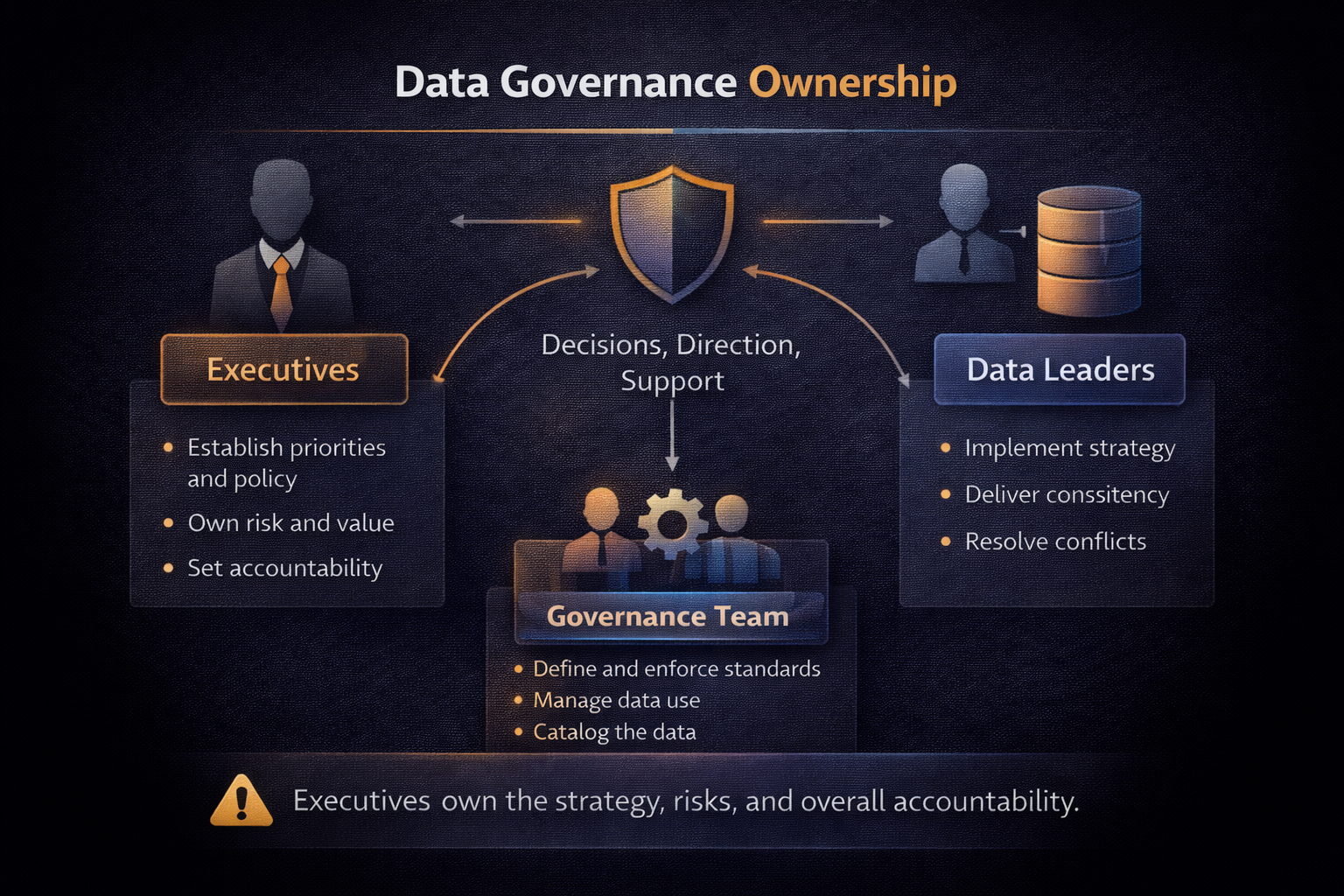
Decision 2. What risk level the organization accepts
Governance slows down when teams treat every dataset as high risk. It fails when teams treat high-risk data as low risk. Executives must set a clear risk posture and enforce it consistently.
- Define which data types require strict controls.
- Set acceptable response time between issue detection and correction.
- Define when exceptions require executive approval.
Decision 3. What standards are mandatory versus recommended
Governance collapses under its own weight when everything is required. Leaders need a small set of non-negotiables and flexible guidance everywhere else.
- Mandatory. Data classification, access controls, and auditability for regulated or high-impact data.
- Mandatory. Shared definitions for key executive metrics.
- Recommended. Extended documentation for lower-impact datasets and local reporting needs.
How governance fails in real organizations
Most governance failures are predictable. They look different on the surface but usually share the same root causes.
- No owners. Data becomes everyone’s job, so no one fixes it.
- Competing definitions. Leaders debate metrics instead of acting on them.
- Tool-first governance. A platform is purchased before ownership and operating rules exist.
- No escalation path. Teams stall when disputes arise.
- Exception creep. Temporary exceptions become permanent operating behavior.
These failures are why leaders should connect governance to adjacent work like data foundations before scaling AI and not treat governance as a parallel project with separate goals.
A governance operating model leaders can run
Executives need a model that fits reality. It must protect speed while raising trust and control. The simplest models usually perform best because they force clarity early.
1. Keep scope tight
- Start with the 10 to 20 datasets that drive executive reporting, customer impact, or regulatory exposure.
- Do not attempt enterprise-wide governance on day one.
2. Create a decision forum with authority
- Keep the group small. Use business owners of domains plus security and delivery representation.
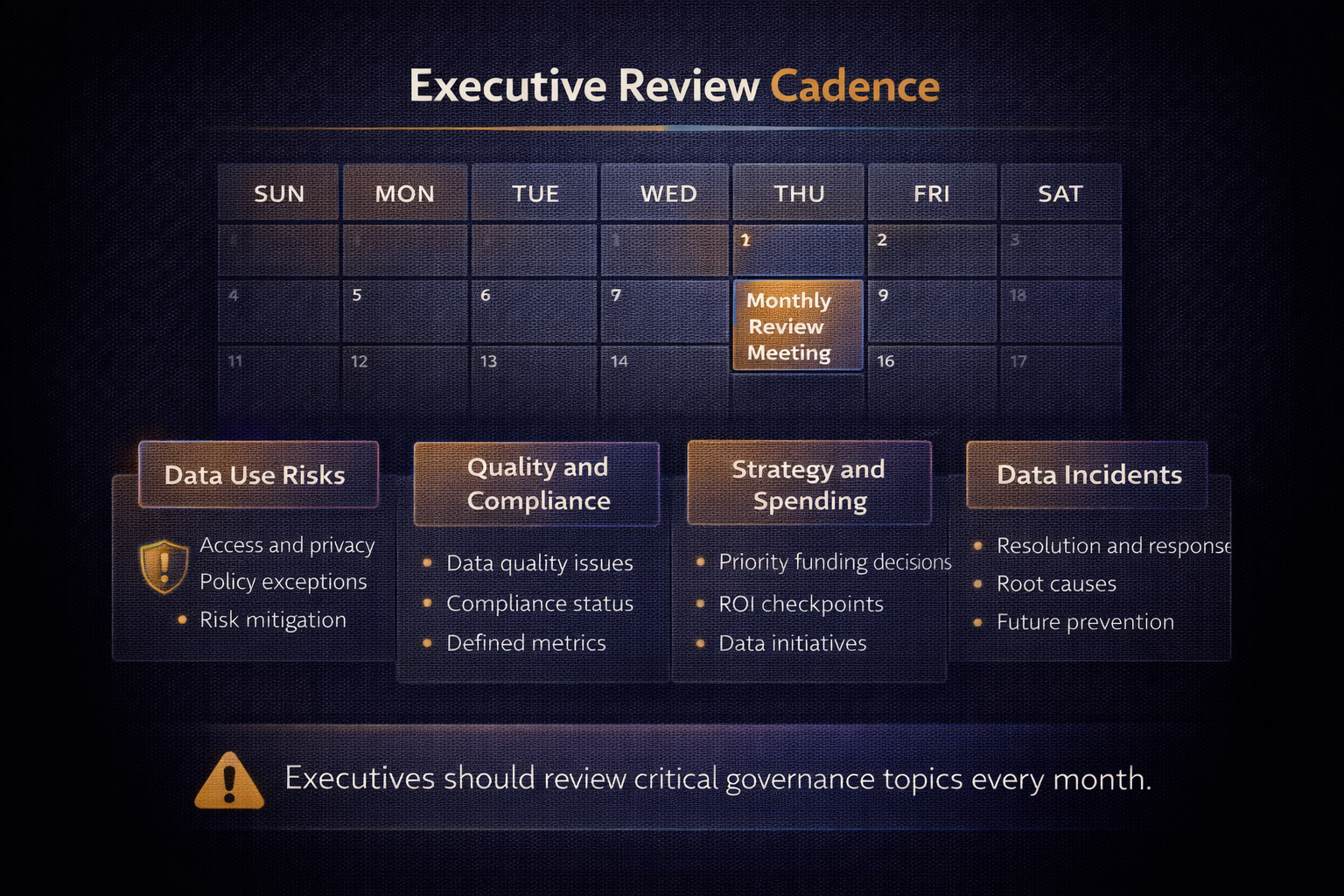
- Meet monthly to resolve disputes, approve standards, and enforce ownership.
3. Establish a weekly operational rhythm
- Stewards track quality issues and resolution progress.
- Owners approve definition changes and major exceptions.
- Leaders review only the issues that need authority or risk judgment.
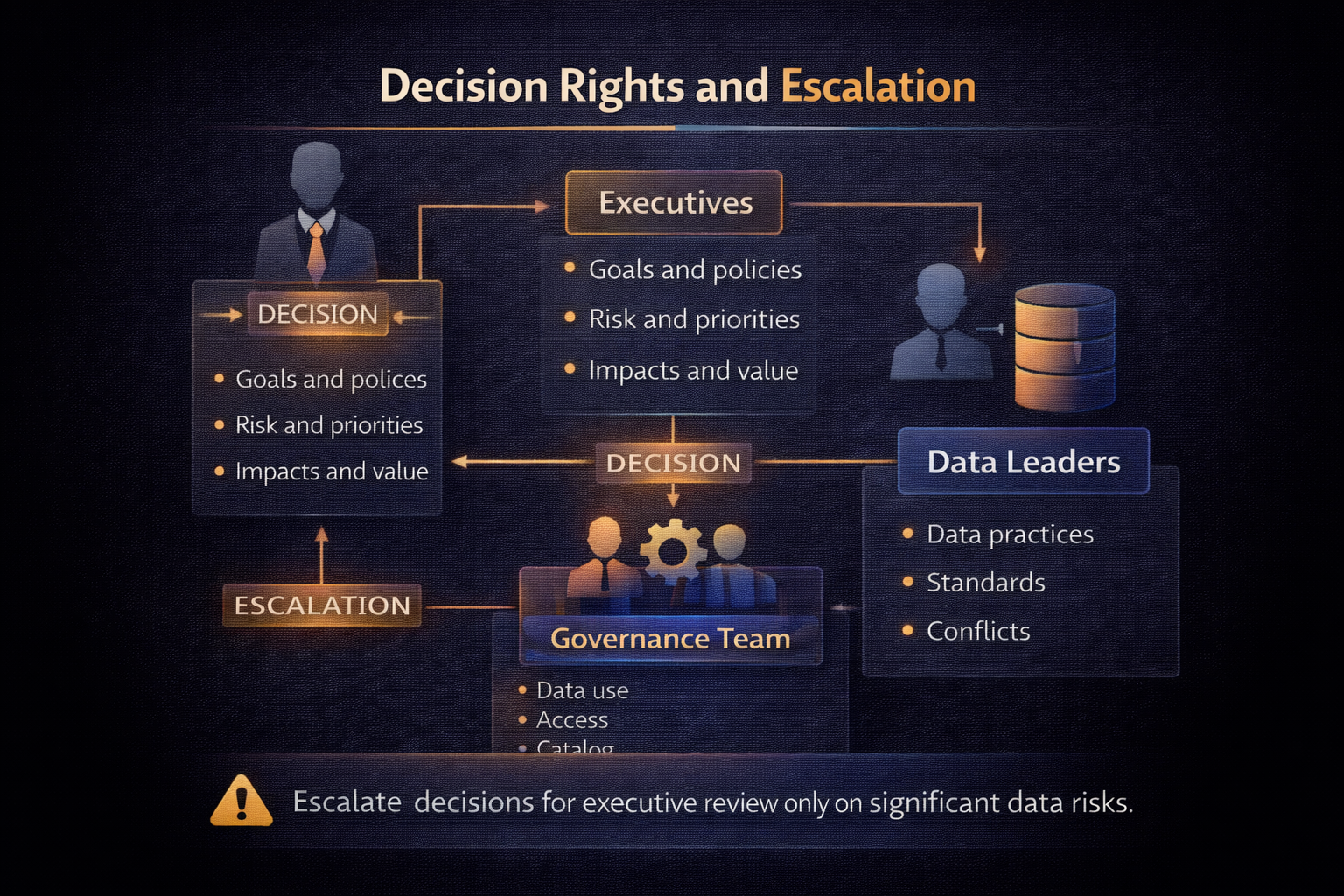
Metrics executives should review monthly
Governance metrics need to drive action. Avoid vanity measures like the number of policies written. Use measures tied to risk, trust, and visible business outcomes.
- Quality. Error rate for priority datasets and time to correction.
- Trust. Reconciliation effort required for executive reporting.
- Access control health. High-risk access exceptions and closure time.
- Lineage coverage. Ability to trace how top metrics are produced.
- Change control. Definition changes to key metrics and sign-off compliance.
These measures work best when they are tied to the same leadership review rhythm used for clear accountability across technology teams. Governance improves when ownership and review discipline reinforce each other.
What success looks like in 90 days
Governance should produce visible results quickly. If it does not, it has turned into process for its own sake.
- Named owners for priority domains and datasets.
- Shared definitions for executive metrics and reporting.
- Fewer data disputes in leadership meetings.
- Reduced manual cleanup and reconciliation work.
- A predictable governance cadence with clear escalation paths.
Quick answers for executives leading governance
- Governance needs executive authority. Teams alone cannot resolve ownership and risk tradeoffs across functions.
- Ownership is the first move. One named owner per critical data domain changes behavior fast.
- Keep the model lightweight. Tight scope and short cadence prevent governance from becoming bureaucracy.
- Measure outcomes, not paperwork. Fewer disputes and less reconciliation matter more than policy counts.
Frequently Asked Questions
Why must executives lead data governance?
Governance requires decisions about ownership, risk tolerance, and cross-team tradeoffs. Executives hold the authority required to enforce those decisions.
What is the most important step in data governance?
Assign a single accountable owner for each critical data domain such as customer, product, finance, or operations.
How often should executives review governance metrics?
A short monthly cadence works best. Leaders review data quality, access exceptions, lineage coverage, and definition changes.
Why do governance initiatives fail?
Most failures occur because data lacks ownership, definitions vary between teams, and escalation paths remain unclear.
How quickly should governance show results?
Within 90 days leaders should see clearer ownership, fewer reporting disputes, and less manual reconciliation.
Need a governance model that protects speed and reduces risk
If teams debate definitions, reports require manual cleanup, or AI initiatives struggle to scale, a short working session will identify the highest-risk domains, assign ownership, and establish a governance cadence leaders can run.
Book a consultation