
Why AI initiatives stall after early success
Many AI pilots succeed in controlled environments. They show promise in demos and early proofs of concept. The trouble starts when leaders attempt to scale.
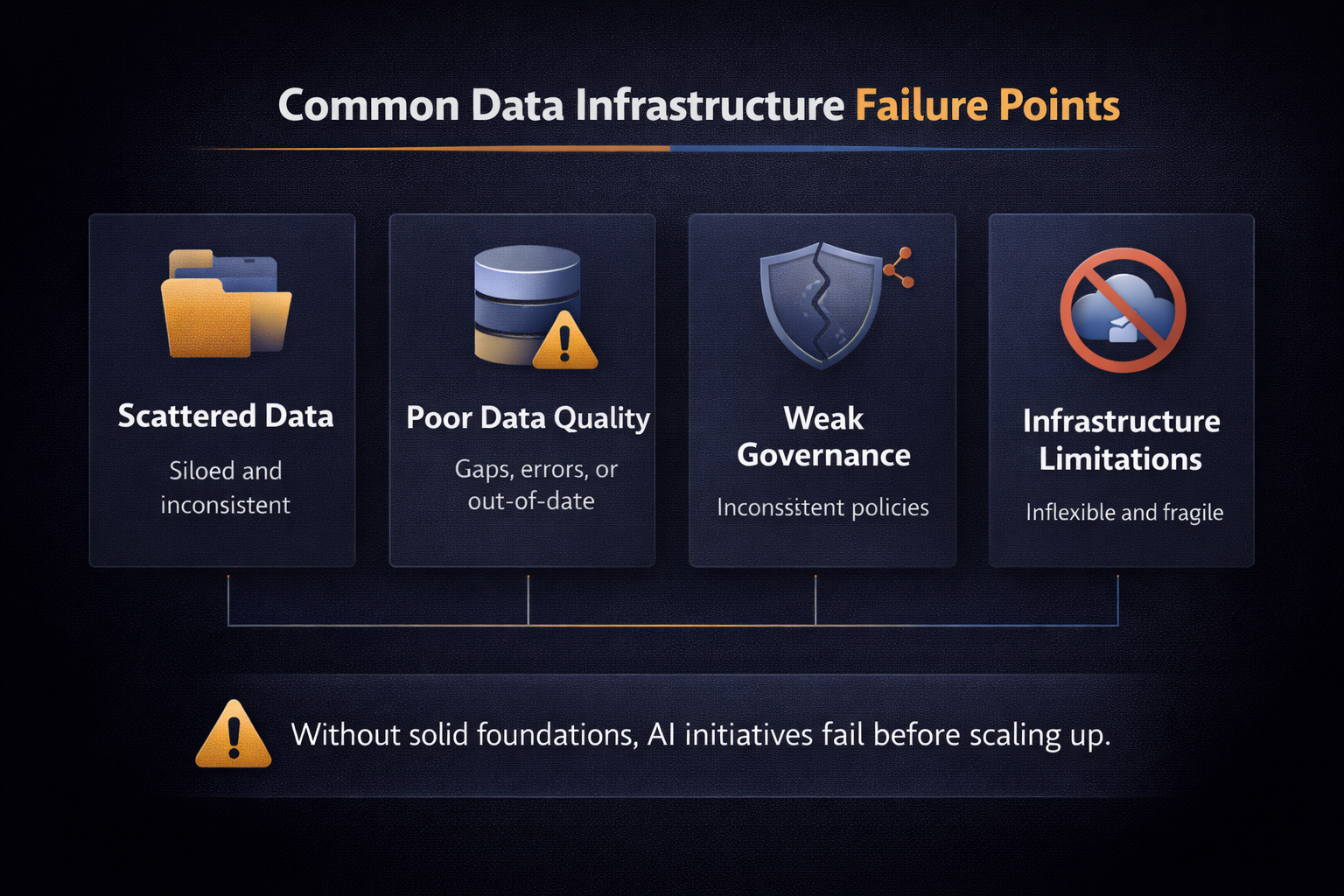
Models rely on clean, consistent, and trusted data. Most organizations do not operate that way today. Data is fragmented across systems, owned by no one, and shaped by legacy processes.
Scaling AI exposes these weaknesses quickly. Accuracy drops. Trust erodes. Teams retreat back to manual processes.
The hidden data problems leaders underestimate
Data issues rarely announce themselves clearly. They appear as model drift, slow delivery, or endless debate about results.
- Inconsistent definitions across teams.
- Manual data corrections baked into workflows.
- Unclear data ownership and stewardship.
- Poor data lineage and traceability.
- Latency that breaks real-time use cases.
Data foundations are a leadership responsibility
Data quality is often treated as a technical problem. In reality, it is an organizational one.
Leaders decide priorities, incentives, and ownership. If data is not governed, it is because leadership has not made it a first-class concern.
Define ownership at the domain level
Every critical dataset needs a named owner. Not a team. Not a committee. A person accountable for quality and usage.
- Business owner accountable for meaning.
- Technical owner accountable for pipelines.
- Clear escalation when quality degrades.
Standardize definitions before models
AI amplifies inconsistencies. If teams disagree on definitions, models will learn the wrong patterns.
- Agree on shared business definitions.
- Document assumptions and exceptions.
- Review definitions quarterly.
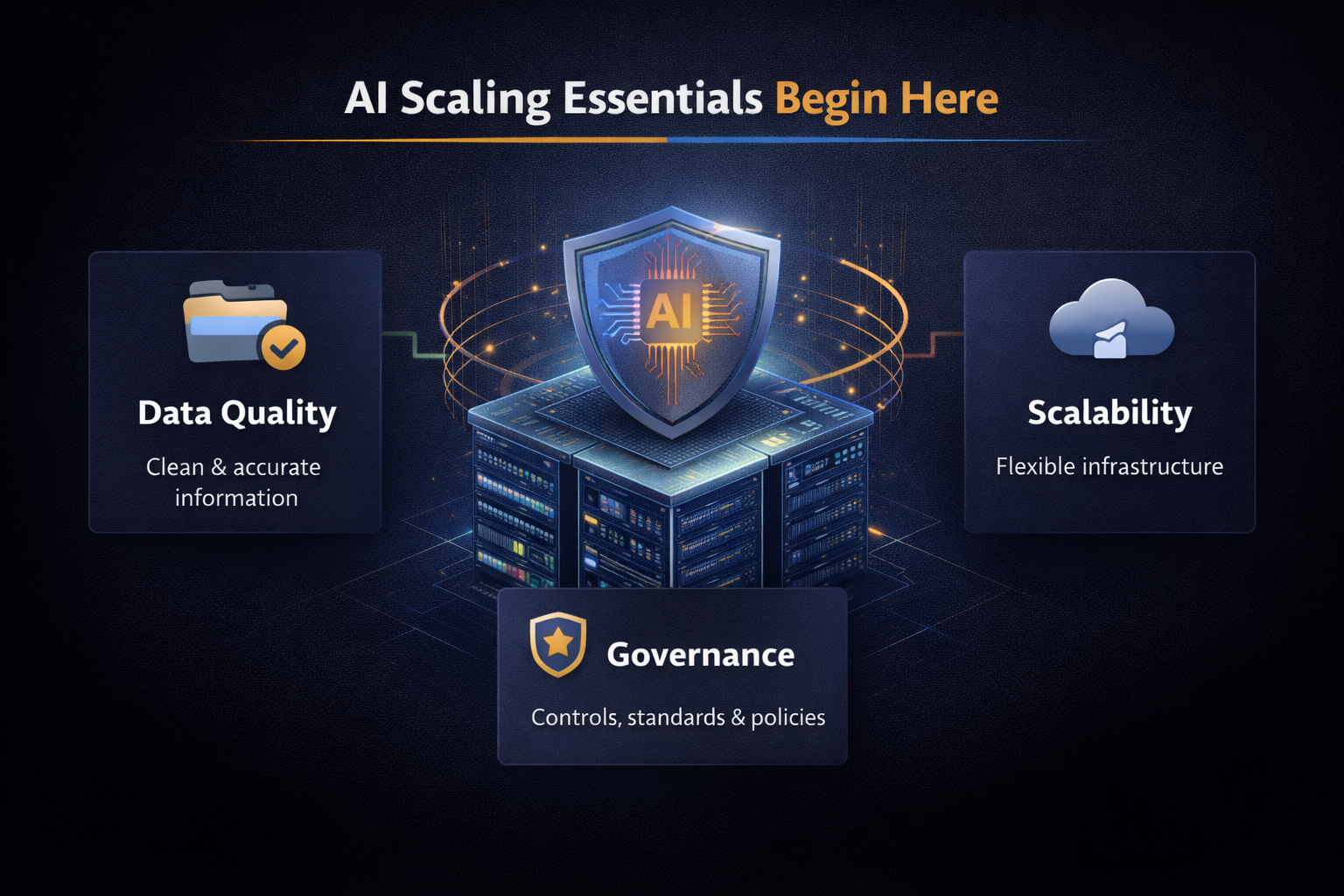
Build foundations before advanced AI
Leaders often rush toward advanced use cases. Predictive models. Autonomous decisions. Generative systems.
Without foundations, these efforts increase risk. They create false confidence and fragile systems.
Focus first on reliability, trust, and repeatability. Advanced AI becomes safer and faster once these exist.
What strong data foundations enable
- Faster model deployment.
- Higher trust from business users.
- Lower operational risk.
- Clearer audit and compliance posture.
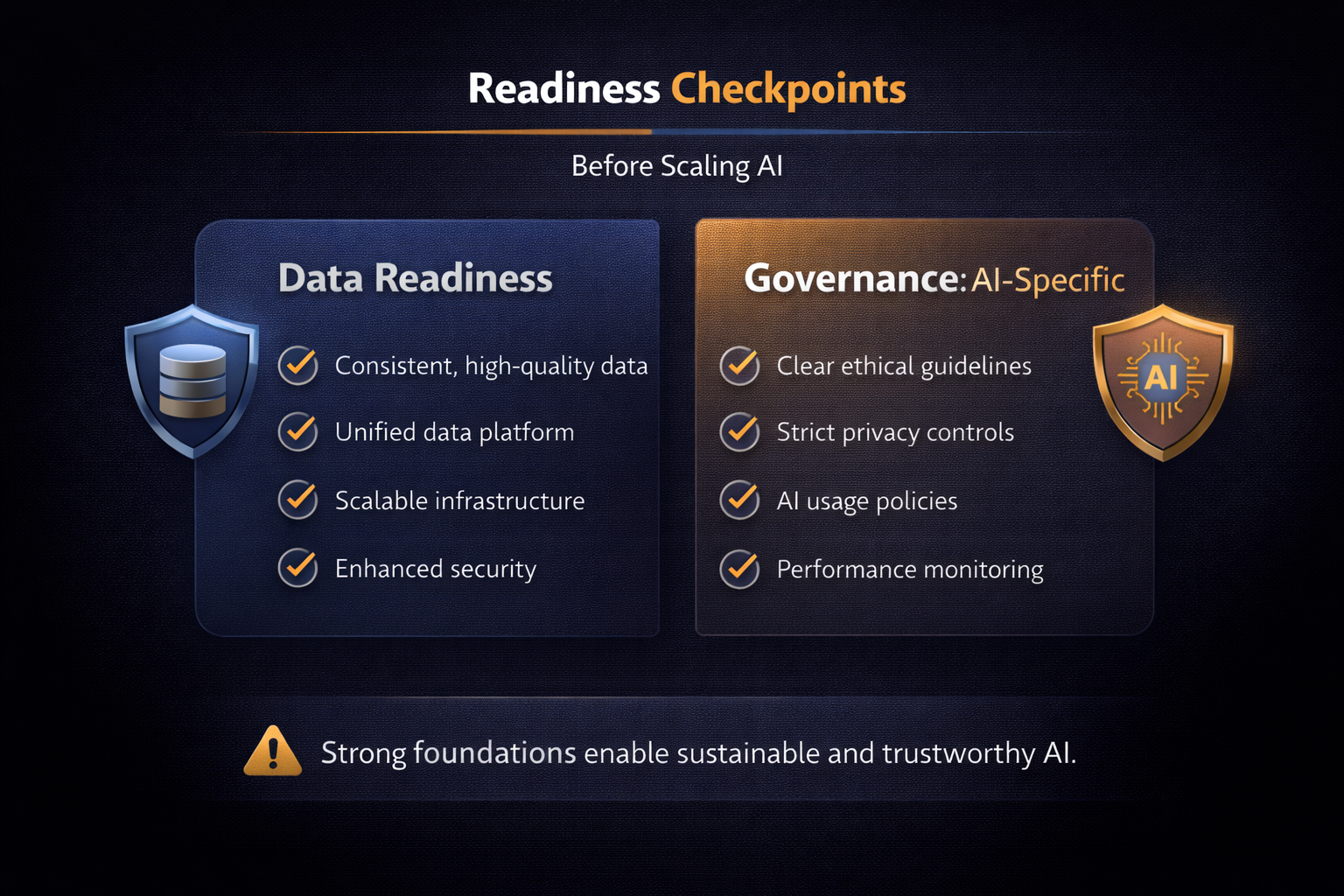
Leaders working through AI readiness decisions often face the same ownership and prioritization issues discussed in other executive guidance across the site. Strong foundations improve reporting, governance, vendor evaluation, and long-term execution quality, not only model performance.
Frequently Asked Questions
Why do AI pilots fail when leaders try to scale them?
AI pilots often fail at scale because definitions differ across teams, ownership is unclear, and quality issues are patched manually instead of fixed at the source.
What data issues should leaders fix first?
Leaders should first assign domain owners, standardize definitions for priority metrics, and remove manual corrections from core workflows that feed reporting, analytics, and AI.
Is data quality mainly a technical problem?
No. Data quality is mainly a leadership and operating model problem because priorities, ownership, escalation, and governance are set by leadership, not by tools alone.
What does strong data ownership look like?
Strong data ownership means every critical dataset has a named business owner for meaning, a technical owner for pipeline reliability, and a clear path for escalation when quality degrades.
What do strong data foundations enable for AI?
Strong data foundations enable faster model deployment, higher trust from business users, lower operational risk, and a clearer audit and compliance posture.
Want AI efforts built on trusted data foundations
Bring one priority AI use case and the datasets that feed it. A working session will identify the ownership gaps, definition issues, and operational controls needed before scale.
Book a consultation