
The AI readiness illusion
Many leaders believe they are ready for AI because they hired AI talent, implemented a modern data platform, ran a successful pilot, or a vendor declared them mature.
These are capability signals. They are not readiness signals.
True readiness is the ability to scale decisions, not experiments.
AI amplifies whatever discipline already exists inside your organization. If strategy is unclear, AI accelerates confusion. If governance is weak, AI magnifies risk. If incentives are misaligned, AI exposes it.
The question is not, “Can we build something with AI.” The real question is, “Can we scale it without losing control.”
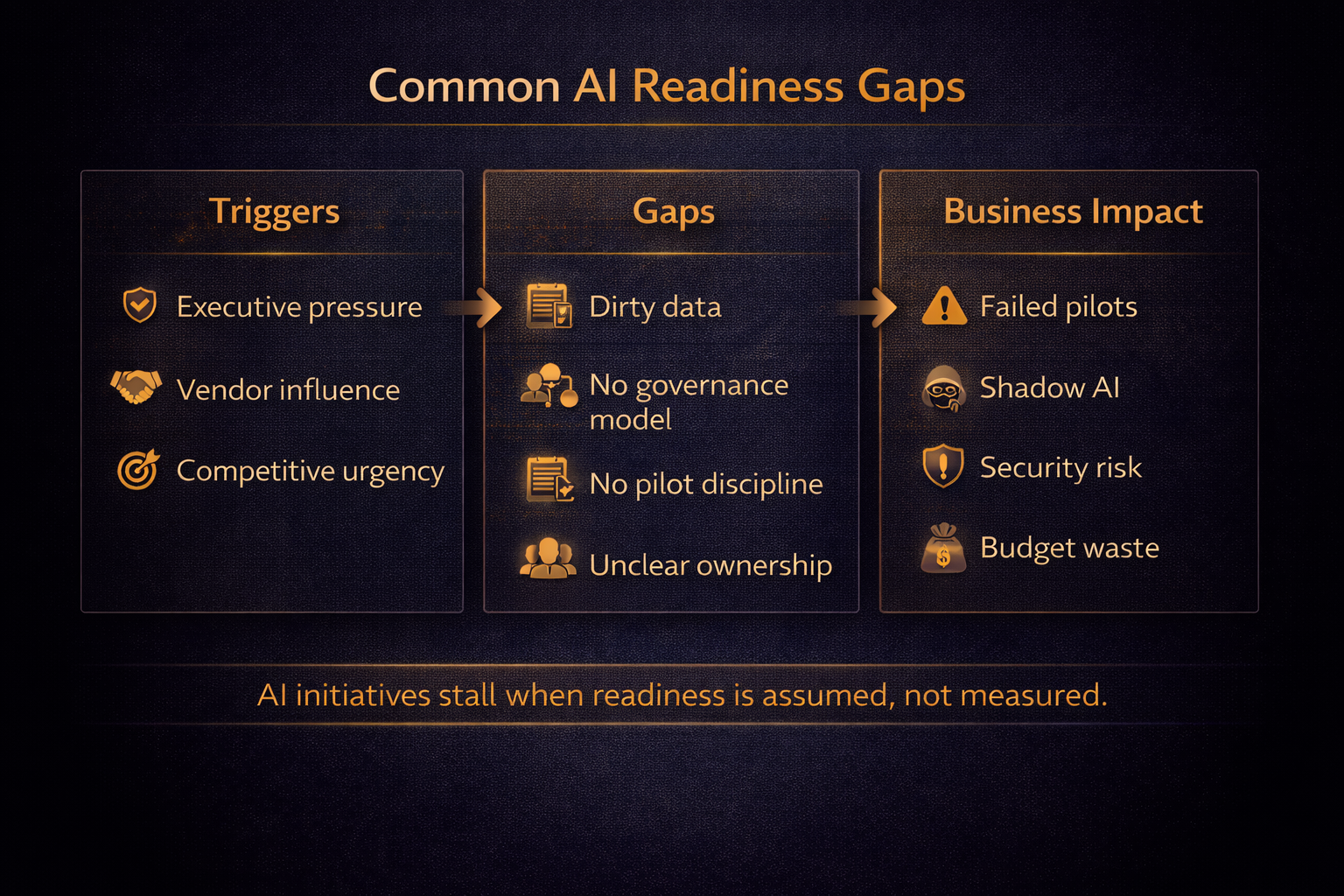
The AI readiness stack
AI readiness rests on four interdependent layers. Weakness in any one layer destabilizes the others.
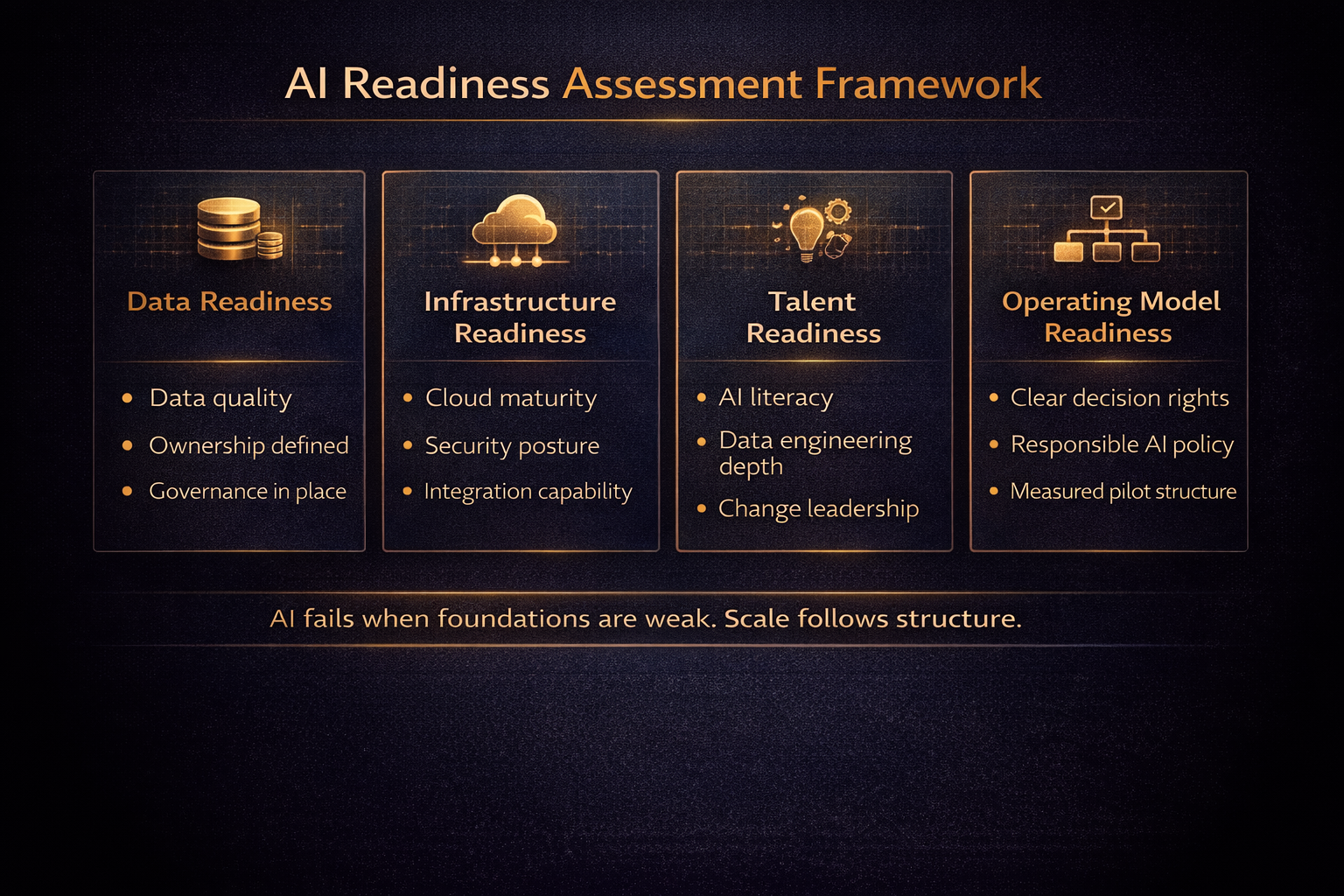
1. Strategic clarity
Leaders must be able to answer what specific business result you are targeting, how you will measure improvement, and what decisions AI will influence.
If the outcome cannot be explained in one sentence, readiness is fragile.
Fragile readiness
- “We are exploring AI use cases.”
- “We want to be more data-driven.”
- “We are modernizing.”
Strong readiness
- Reduce claims processing time by 20 percent within six months.
- Increase cross-sell conversion by 10 percent using targeted recommendations.
AI without defined decision context turns into experimentation theater.
2. Data integrity
You are not ready if ownership of datasets is unclear, definitions vary across departments, quality issues are normalized, or access requires manual intervention.
AI systems do not fix inconsistency. They scale it.
Strong readiness includes
- Named data owners.
- Standardized definitions.
- Active governance processes.
- Reliable system integration.
3. Operating discipline
Operational readiness determines whether AI initiatives move beyond pilots.
Ask whether there is a defined decision cadence, whether AI initiatives are embedded into core workflows, whether there is a clear owner accountable for outcomes, and whether change management is structured or reactive.
Fragile operating models look like isolated pilots with no integration plan, AI dashboards disconnected from frontline processes, and executive enthusiasm without operational sponsorship.
Strong operating discipline means AI becomes part of how work is done, not an adjacent experiment.
4. Organizational alignment
This is the layer most leaders underestimate.
You are not ready if incentives reward activity instead of outcomes, managers resist data-driven decisions, teams fear automation more than inefficiency, or leadership signals conflict about priorities.
Organizational readiness means clear executive sponsorship, transparent communication, aligned performance metrics, and skills investment where required.
AI readiness is cultural as much as technical.
Executive diagnostic. Five questions before you scale
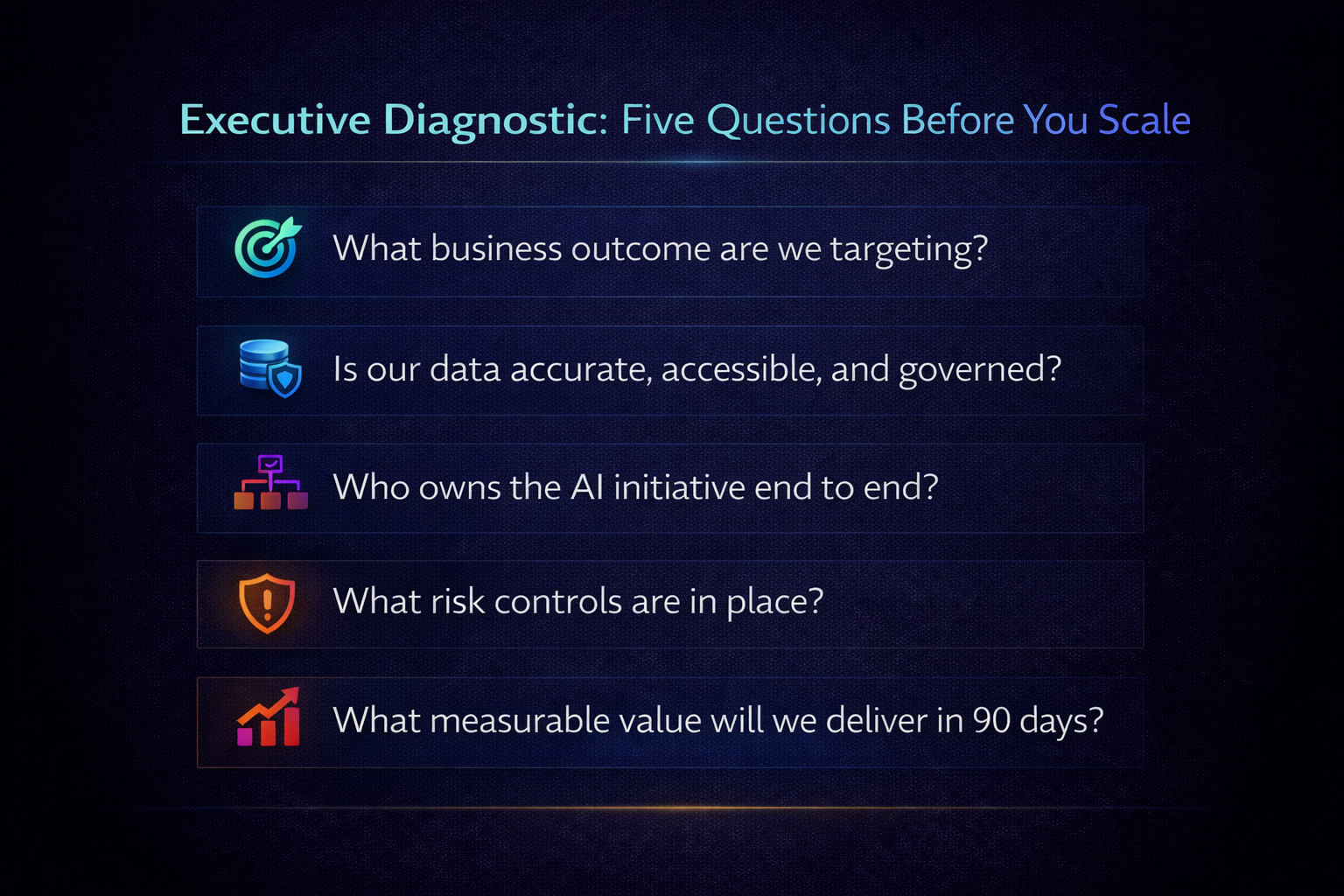
- Can we name the decision AI will improve?
- Is the required data owned, governed, and trusted?
- Do we have a clear operating model for deployment?
- Is someone accountable for measurable business impact?
- Will the organization adopt the output of the system?
If two or more answers are unclear, scale increases instability faster than value.
What to fix first
If strategy is unclear, pause experimentation and clarify outcomes.
If data is unstable, invest in governance before scaling models.
If operating discipline is weak, strengthen decision cadence and ownership.
If incentives are misaligned, fix leadership alignment before expanding AI investment.
Sequencing determines success more than technology choice.
This is why readiness work connects directly to data foundations before scaling AI and to the executive role in data governance. Leaders who fix those issues first reduce rework, risk, and false starts.
The real risk
The risk is not that AI fails technically. The risk is decision velocity collapse, costs rising without measurable value, leadership credibility erosion, and organizational trust decline.
AI magnifies what already exists inside your business. Strengthen the foundation before increasing the amplification.
Frequently Asked Questions
What does AI readiness mean?
AI readiness means your organization can scale AI driven decisions without increasing risk, instability, or misalignment.
How do leaders assess AI readiness?
Leaders assess readiness by checking strategic clarity, data integrity, operating discipline, and organizational alignment.
Is a pilot proof of AI readiness?
No. A pilot proves capability. Readiness is proven through repeatable deployment into real workflows with measured impact.
What should leaders fix first when readiness is weak?
Leaders should fix the weakest foundational layer first. That often means clarifying outcomes, stabilizing data governance, strengthening ownership, or aligning incentives before scaling AI.
What is the biggest risk of scaling AI too early?
The biggest risk is loss of control. Costs rise, trust drops, decision quality weakens, and leadership credibility erodes before measurable value appears.
Need an executive-level AI readiness assessment
If you are evaluating AI investments and want a practical readiness view, a short working session will map your current maturity, decision discipline, and risk exposure.
Book a consultation