
Why burnout accelerates during growth
Scaling exposes every weak point in the operating model. Intake expands faster than prioritization. Cross-team dependencies multiply. Decision paths get longer. Teams end up carrying more work than leadership can realistically support.
This usually starts with good intent. Revenue is growing. New demands keep arriving. Leaders want momentum. So the organization says yes too often and delays hard tradeoff decisions.
At first, teams absorb the pressure. They work longer hours. They switch contexts more often. They compensate for weak planning and inconsistent governance. This looks productive for a short period. Then the costs appear. Cycle times stretch. Quality drops. Incident risk rises. Delivery confidence falls.
Burnout during growth is rarely caused by weak people. It is usually caused by weak portfolio control.
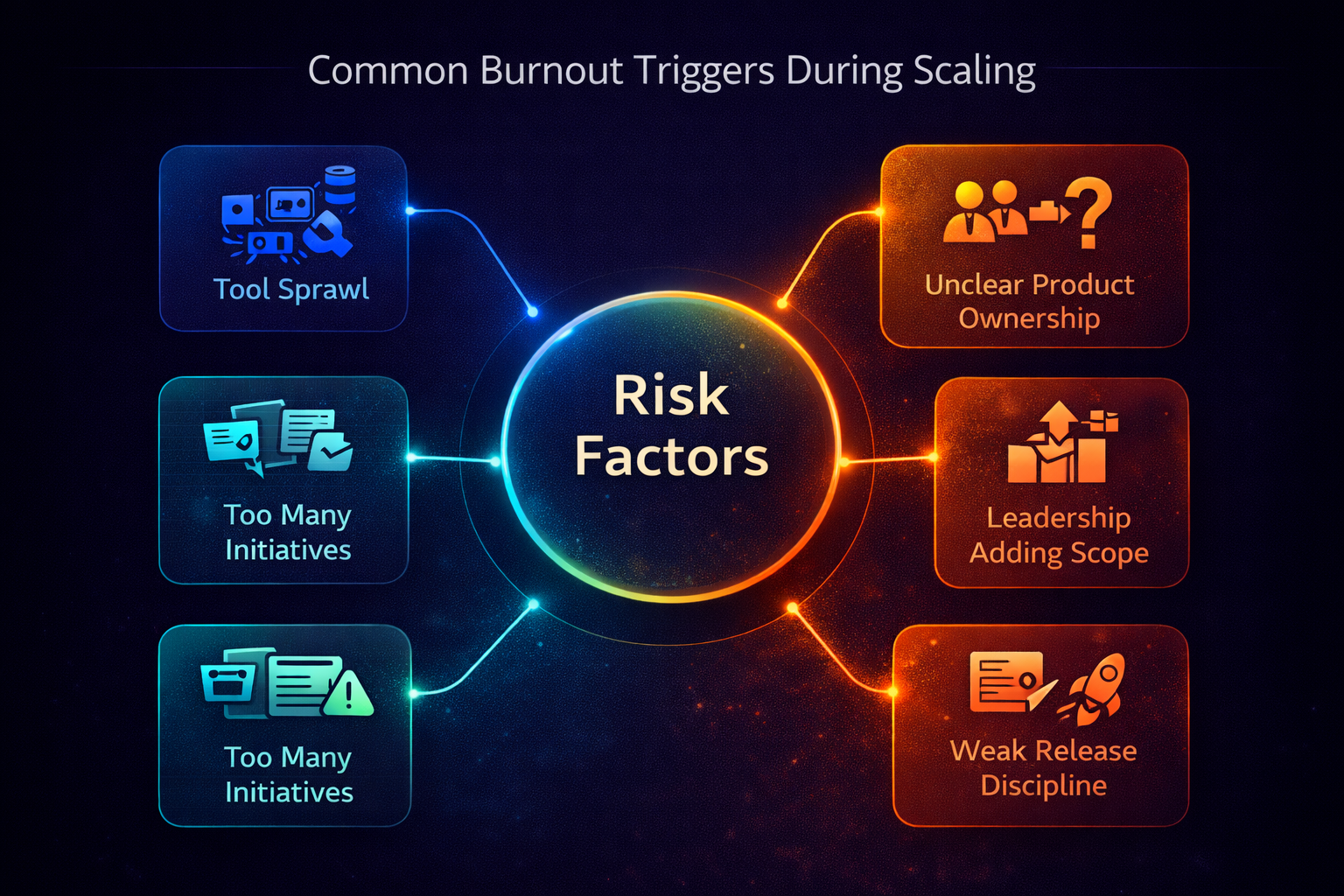
Common triggers during expansion
Burnout rarely comes from one dramatic failure. It builds from repeated friction leaders normalize during a growth phase.
- Too many concurrent initiatives. Teams divide attention across work that should not be running at the same time.
- Scope added without subtraction. New work enters the system, but nothing meaningful leaves it.
- Unclear ownership. Decisions stall when accountability is shared broadly and owned by no one.
- Weak release discipline. Delivery becomes stressful when shipping lacks standards, rollback readiness, or predictable cadence.
- Tool sprawl. More platforms create more context switching, more support work, and more hidden coordination overhead.
The hidden cost of over-scaling
Burnout is not only a people issue. It is a business risk. Quality declines. Security gaps widen. Escalations increase. Delivery predictability drops. Customer trust erodes when teams operate in constant overload.
Leadership often sees the direct cost of hiring. It undercounts the cost of churn, rework, delayed releases, and production instability. Replacing a senior technologist often costs 1.5 to 2 times salary once recruiting effort, transition time, and lost productivity are included.
Even before attrition happens, over-scaling damages margin. Teams spend more time coordinating work, revisiting decisions, and repairing rushed outcomes. More activity shows up on the roadmap. Less real throughput reaches the business.
The sustainable scaling model
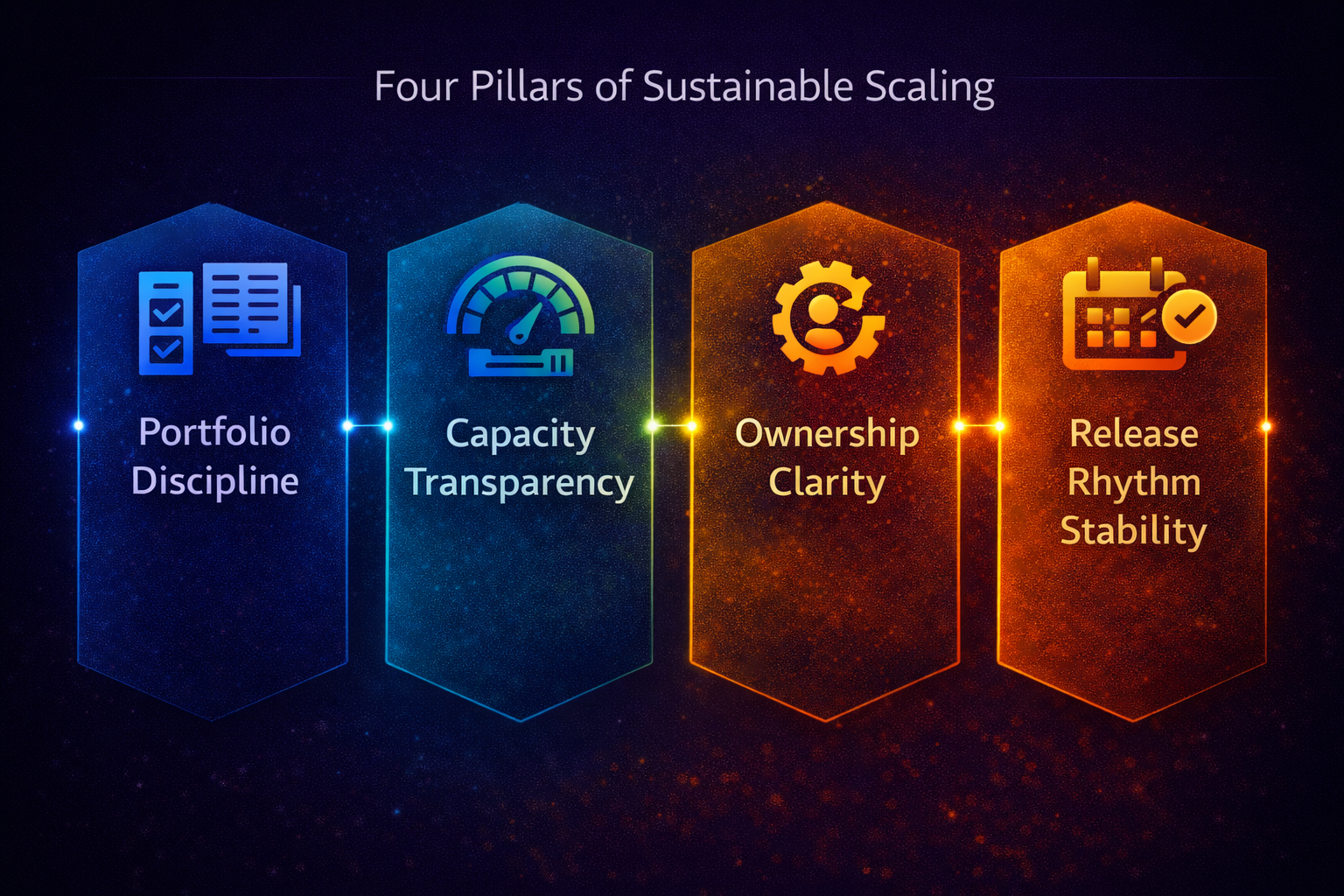
Healthy scaling is not built on effort alone. It is built on an operating model that keeps demand aligned to realistic delivery capacity.
1. Portfolio discipline
- Limit the number of active initiatives.
- Prioritize by business value, risk reduction, and strategic timing.
- Say no early so teams do not fail late.
2. Capacity transparency
- Know true bandwidth by team, platform, and critical dependency.
- Separate planned capacity from emergency support and operational load.
- Stop treating theoretical capacity as available capacity.
3. Ownership clarity
- Assign one accountable leader per priority.
- Clarify who makes tradeoff decisions and who resolves blockers.
- Reduce cross-functional ambiguity before deadlines tighten.
4. Release rhythm stability
- Protect a predictable delivery cadence.
- Define release standards, rollback expectations, and operational readiness.
- Do not let urgency destroy process maturity.
Leadership intervention framework
When signs of burnout appear, leaders should not respond with broad encouragement alone. They need to reduce pressure inside the system.
- Pause intake temporarily. Stop adding work until the current portfolio is visible and ranked.
- Audit active initiatives. Identify what is truly in flight, who owns it, and what value it is expected to deliver.
- Rank work by strategic value and business impact. Separate must-win priorities from noise.
- Freeze low-impact work. Protect capacity for what matters most.
- Reset workload expectations and timelines. Recommit based on reality, not optimism.
- Clarify decisions and dependencies. Resolve long-standing blockers before asking teams to move faster.
The weekly scoreboard leaders should review
A short operating scoreboard helps leaders see drift before it becomes burnout, churn, or delivery failure.
- Active initiatives. Total number in flight versus the agreed portfolio limit.
- Capacity load. Committed work versus available delivery bandwidth.
- Decision aging. Number of unresolved decisions blocking execution for more than one week.
- Release predictability. Planned releases versus completed releases and rollback events.
- Production health. Open incidents, recurring incidents, and support escalation volume.
- Rollover work. Priorities repeatedly pushed into the next cycle.
- Team strain signals. Persistent weekend work, emergency handoffs, and avoidable after-hours recovery effort.
Leaders do not need a long dashboard. They need a short set of signals that force earlier action.
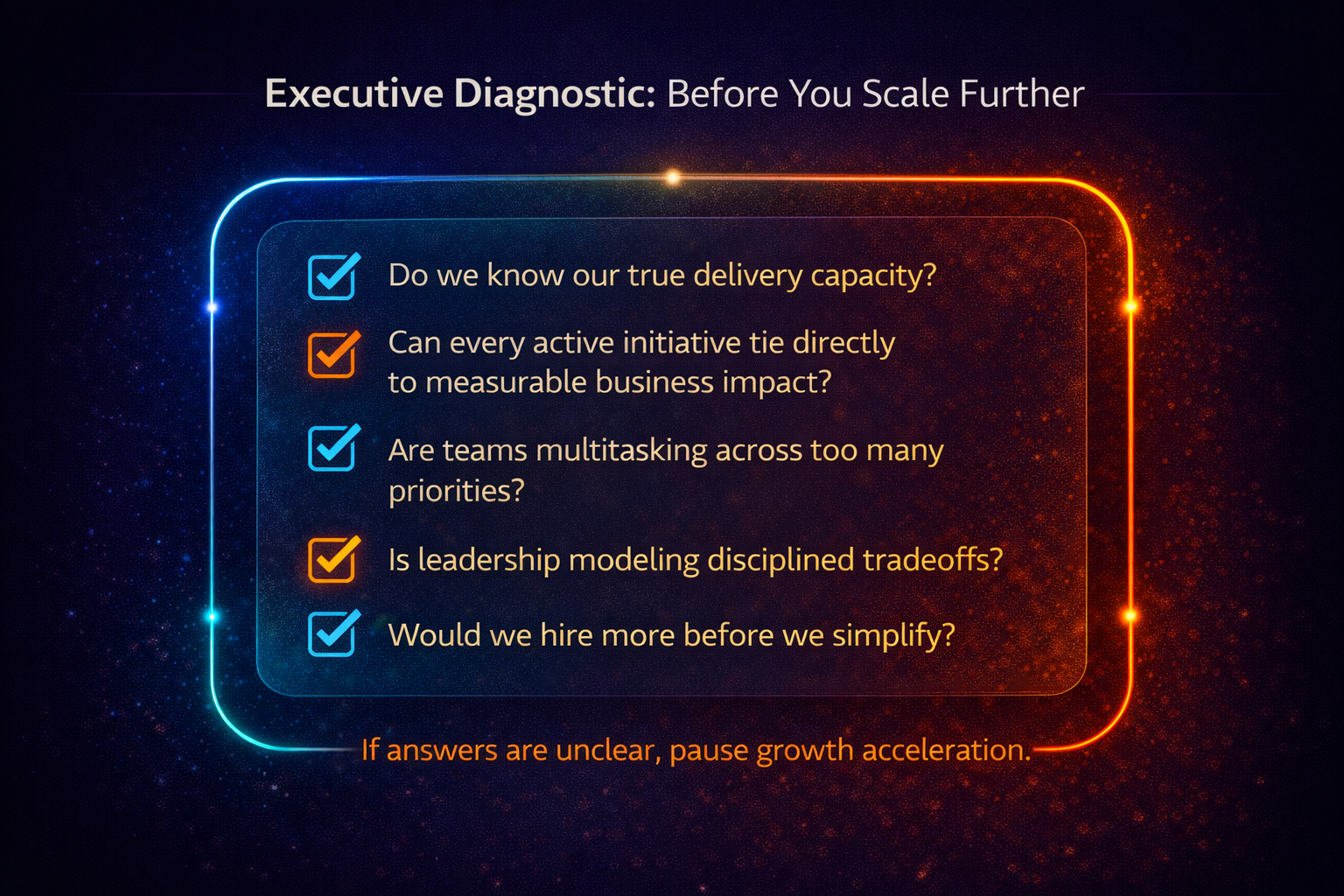
Executive diagnostic
Ask these questions before approving more work, more hiring, or more aggressive timelines.
- Do we know true capacity by team and platform, or are we operating on assumptions.
- Can every active initiative tie to a measurable business outcome.
- Are teams multitasking across too many competing priorities.
- Is leadership modeling disciplined tradeoffs, or adding work without removing work.
- Do we have one accountable owner per major priority.
- Would simplification improve throughput faster than more hiring.
- Is our release process stable enough to support growth without constant heroics.
Operating cadence that protects teams while you grow
Weekly leadership review
- Review the scoreboard.
- Resolve blocked decisions.
- Confirm what enters, what exits, and what stays paused.
Monthly portfolio review
- Assess active initiatives against strategic value and delivery health.
- Freeze or remove work that no longer justifies scarce capacity.
- Reconfirm ownership and timeline realism.
Quarterly operating reset
- Review capacity assumptions, role coverage, and recurring friction.
- Address tool overlap and workflow complexity.
- Decide whether simplification, process improvement, or selective hiring deserves priority.
What healthy scaling looks like
Healthy scaling is not slower. It is cleaner. Teams know what matters. Leaders make tradeoffs earlier. Releases are more predictable. Fewer priorities die in the middle because the organization stops overloading itself at the start.
- Teams finish more work because they are carrying less unnecessary work.
- Quality improves because rushed decisions and unstable releases decline.
- Leaders gain visibility because ownership and reporting are tighter.
- Hiring becomes more effective because new capacity enters a stable system.
- Growth feels demanding, but it no longer feels chaotic.
Quick answers for leaders scaling fast
- Do not add work without subtraction. Intake control is the fastest burnout prevention move.
- Do not confuse activity with throughput. More initiatives often reduce real output.
- Do not hire into chaos first. Stabilize the operating model so added capacity has a fair chance to perform.
- Do not wait for attrition to act. Burnout shows up in delivery patterns well before resignations appear.
Frequently Asked Questions
Why do technology teams burn out during growth?
Technology teams burn out during growth when demand expands faster than operating discipline. Too many concurrent initiatives, slow tradeoff decisions, unclear ownership, and unstable release practices create sustained overload.
What is the first leadership move to reduce burnout risk?
The first move is to control intake. Leaders should pause low-value additions, review active initiatives, rank work by business impact, and reset commitments to match true capacity.
Does hiring more people solve scaling pressure?
Hiring helps only when the operating model is already disciplined. If prioritization, ownership, and release management are weak, more people often add coordination overhead and increase friction instead of improving throughput.
What should executives track each week while scaling?
Executives should track active initiatives, committed versus available capacity, open production issues, release predictability, decision aging, and signs of team overload such as persistent rollover work and increased escalations.
What does healthy scaling look like?
Healthy scaling shows up as stable release rhythm, clear ownership, controlled intake, realistic capacity planning, faster decisions, and consistent delivery quality without relying on chronic overwork.
Need to stabilize while growing
If scaling feels chaotic, priorities keep colliding, or teams are stretched too thin, a focused working session will help reset portfolio load, clarify ownership, and restore execution discipline.
Book a consultation