
Why vendor leverage disappears without anyone noticing
Most vendor relationships begin with speed. A team needs a tool. A leader approves it. Work moves forward.
Then the product becomes part of how the business operates. Teams build routines around it. Data accumulates in it. Processes adapt to it.
Leverage drops when switching feels impossible. At that point, negotiations become acceptance of terms.
The hidden cost categories leaders undercount
1. Total cost beyond the license
- Professional services used to compensate for weak adoption or unclear requirements.
- Premium support because SLAs are vague and escalations become routine.
- Integration, reporting, and data pipeline work carried by internal teams.
2. Operating friction
- More tools create more logins, more permissions, and more onboarding time.
- Delivery slows when teams build around vendor constraints.
- Incidents last longer when ownership spans vendor and internal teams.
3. Renewal margin leakage
- Late renewals remove leverage and force fast decisions.
- Auto-renew clauses and bundles reduce flexibility.
- Seat creep inflates spend when access is not governed.
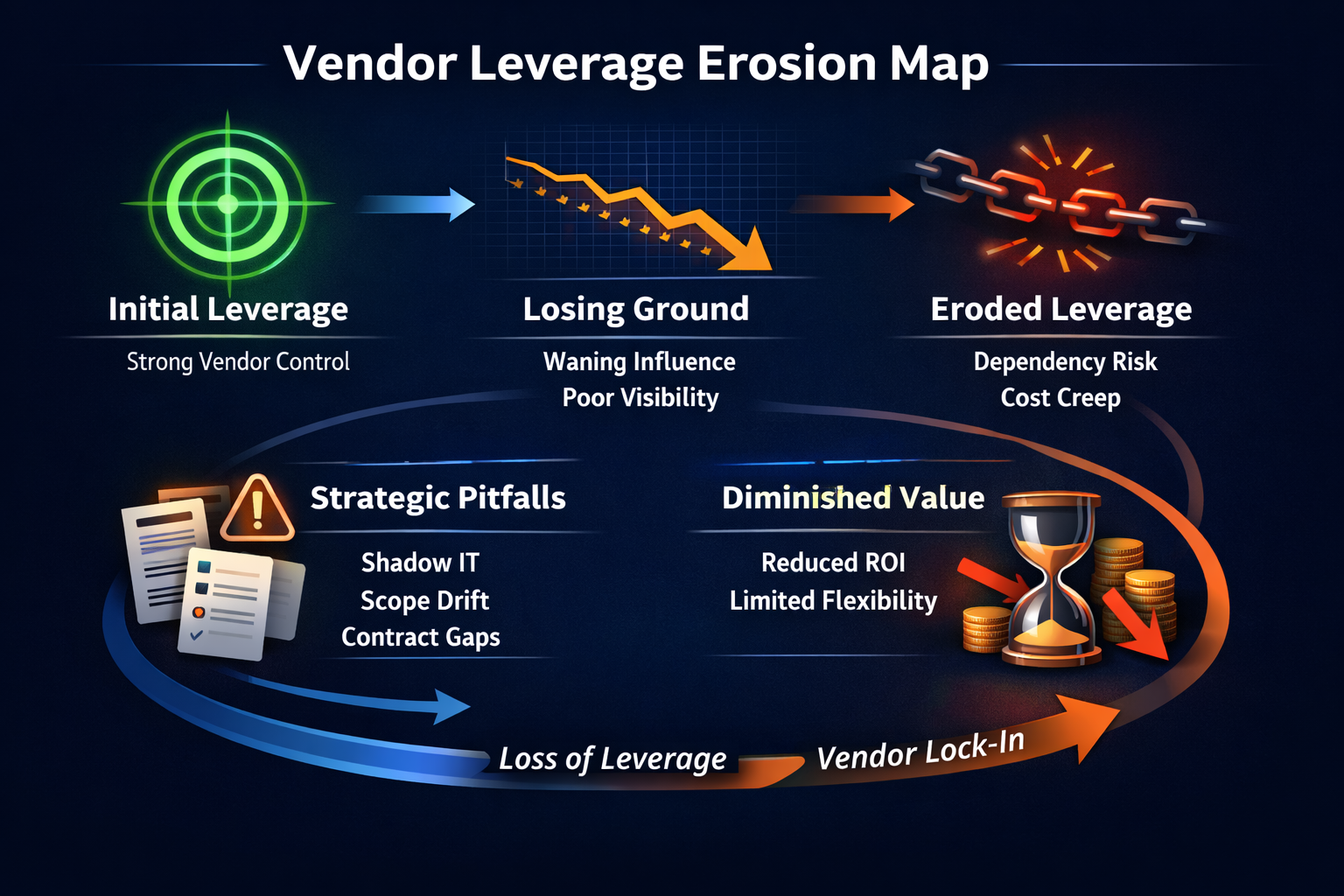
The five leverage killers
- No vendor owner. Nobody owns outcomes, adoption, and renewal readiness.
- Tool overlap. Duplicates weaken negotiating position and confuse teams.
- Unmanaged access. Excess seats inflate cost and increase security exposure.
- Weak contract standards. Terms vary, evidence disappears, and risk shifts to you.
- No exit path. If you cannot leave, every discussion becomes a price increase discussion.
A vendor governance model leaders can run
Procurement helps. Security helps. Technology teams help. Leverage returns when executives set the operating model.
Assign a named owner for each strategic vendor
- One accountable leader for value, adoption, renewal prep, and risk follow-through.
- Owners partner with procurement and security. They do not replace them.
Define decision rights
- Who approves new vendors.
- Who approves renewals and term changes.
- When exceptions require executive sign-off.
Standardize minimum contract terms
- Data ownership, retention, and portability.
- Security controls, audit evidence, and incident notification timelines.
- SLAs tied to business impact, plus escalation paths and response expectations.
This governance structure works best when paired with the same ownership discipline used in creating accountability across technology teams and the same spend review mindset described in aligning technology spend to business outcomes.
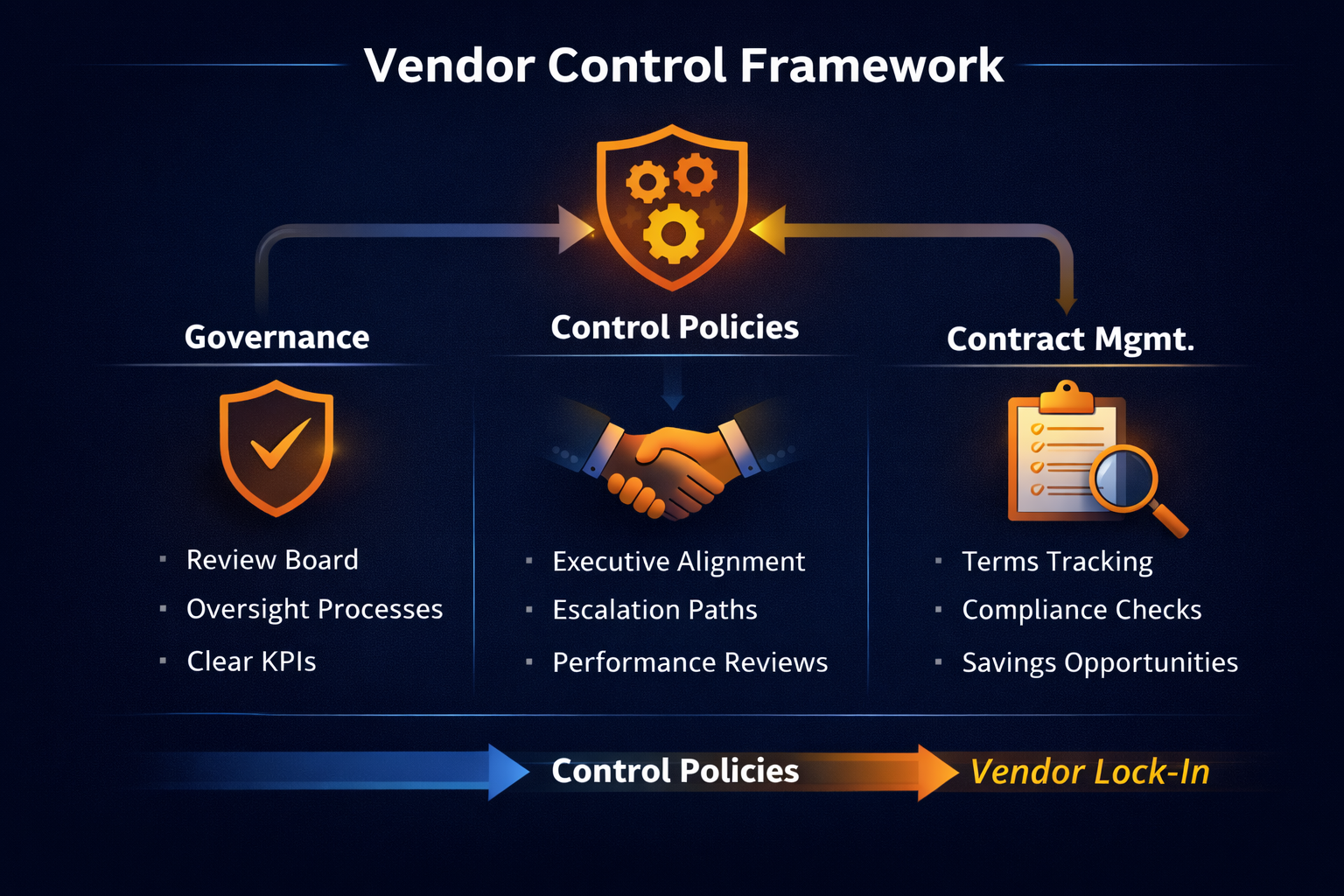
The vendor scorecard executives should review
Keep the scorecard short. Executives need signals that drive decisions.
- Outcome alignment. What business outcome the vendor supports.
- Adoption quality. Whether the right teams use the product consistently.
- Cost integrity. Seats, add-ons, services, and internal support burden.
- Operational impact. Incidents, responsiveness, and delivery friction.
- Risk posture. Data classification, access governance, audit evidence.
- Exit readiness. Time, cost, and plan to migrate if needed.
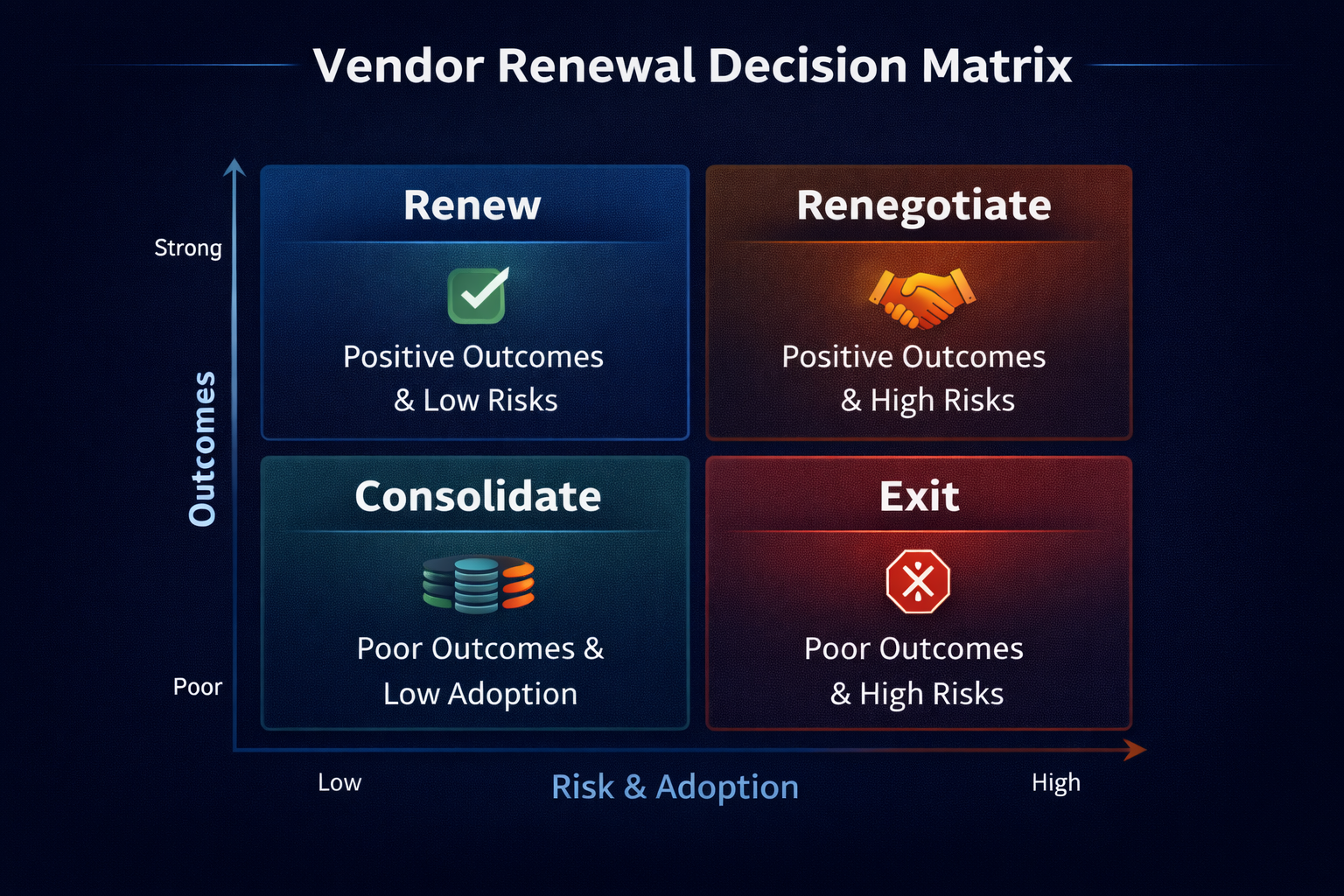
Renewal decision matrix
Renewals should be decisions, not events. Use one matrix to decide whether to renew, renegotiate, consolidate, or exit.
- Renew. Strong outcomes, strong adoption, acceptable risk, competitive pricing.
- Renegotiate. Outcomes strong but pricing, terms, or support are misaligned.
- Consolidate. Overlap exists and the portfolio can be simplified.
- Exit. Weak outcomes, weak adoption, rising risk, or no longer aligned to strategy.
Operating cadence that keeps leverage
Monthly operational review
- Adoption trends and seat hygiene.
- Open incidents and support responsiveness.
- Security actions and evidence status.
Quarterly executive review
- Scorecard review for top vendors.
- Consolidation decisions and exit funding.
- Renewal pipeline for the next two quarters.
Executive decision checklist for renewals
Use this list to avoid late renewals and weak terms. Require answers in plain language with one accountable owner.
- What outcome does this vendor support, and what KPI moved in the last quarter.
- What percent of licensed seats were active in the last 30 days, and what is the seat reclaim plan.
- What add-ons and services were purchased, and what problem each one solved.
- What incidents involved this vendor, and what changed to prevent repeat incidents.
- What sensitive data lives in the platform, and what evidence proves required controls.
- What is the next best alternative, and what would it cost to migrate.
- What terms protect you this year, and what terms create lock-in.
Contract terms that protect leverage
Standardize terms so renewals stop feeling unique. Strong terms reduce risk and force cleaner vendor behavior.
- Data rights and portability. Ownership, export formats, timelines, and support during migration.
- Security evidence. Audit reports, control attestations, and evidence delivery timelines.
- Incident response. Notification windows, escalation paths, and post-incident reporting requirements.
- SLA enforcement. Credits tied to business impact, plus clear severity definitions.
- Price protections. Limits on escalators, add-on pricing control, and renewal notice requirements.
- Auto-renew controls. Early notice windows and explicit renewal approvals for strategic vendors.
Consolidate versus exit
These moves sound similar. The decision triggers differ.
Consolidate when overlap is the real problem
- Two or more vendors solve the same core job.
- Adoption is split and teams argue over tools.
- Reporting requires manual reconciliation across platforms.
- License growth follows politics, not usage.
Exit when risk or value breaks the deal
- Outcomes do not justify the total cost curve.
- Security or compliance obligations are weak, slow, or non-verifiable.
- Support response fails under real incident conditions.
- Terms block portability or force long commitments without proof of value.
Frequently Asked Questions
What does vendor leverage mean for executives?
Vendor leverage is your ability to change terms, enforce performance, and exit without business disruption. Leverage improves when renewal timelines are visible, owners are accountable, alternatives are viable, and switching cost stays manageable.
When should we start renewal planning?
Start 120 to 180 days before renewal for strategic vendors. Early preparation allows you to validate usage evidence, assess alternatives, model consolidation, and negotiate from strength rather than urgency.
What belongs in an executive vendor scorecard?
Keep it short and decision-focused. Track outcome alignment, adoption quality, total cost drivers, operational impact, risk posture, and exit readiness. If a scorecard does not drive renew, renegotiate, consolidate, or exit decisions, it is too complex.
What contract terms protect leverage most?
Data ownership and portability, retention and deletion rights, security evidence obligations, incident notification timelines, SLA enforcement tied to business impact, and limits on auto-renew and price escalators preserve leverage and protect exit options.
How do we decide whether to renew, renegotiate, consolidate, or exit?
Use a structured matrix based on outcome alignment, adoption quality, risk exposure, total cost curve, and exit readiness. Make the decision early. Late decisions eliminate leverage.
Want vendor control without slowing delivery
If renewals keep surprising you, vendors hold sensitive data without clear controls, or tool overlap is driving cost, a short working session will produce an ownership model, a scorecard, and a renewal pipeline leaders can run.
Book a consultation