
The hidden cost of stalled initiatives
Stalled initiatives look quiet. The harm is not quiet. Spend continues. Leadership meetings multiply. Teams keep context switching. Vendors keep invoicing. Meanwhile, the outcome you funded does not move.
The cost shows up in four places. First, wasted capacity. People stay assigned to work that does not ship value. Second, credibility loss. Sponsors stop trusting delivery forecasts. Third, risk accumulation. Controls get deferred, debt grows, and audit exposure increases. Fourth, opportunity cost. High value work gets pushed out because your best teams are stuck in a slow program.
Leaders often treat stalls as execution problems. They push for status decks. They add governance layers. They add headcount. If the stall is a governance failure, those moves increase cost without changing the system that caused the stall.
How to tell a stall from a delay
A delay still has movement. The plan is credible. The blockers are known. The team can explain what changed and what will happen next.
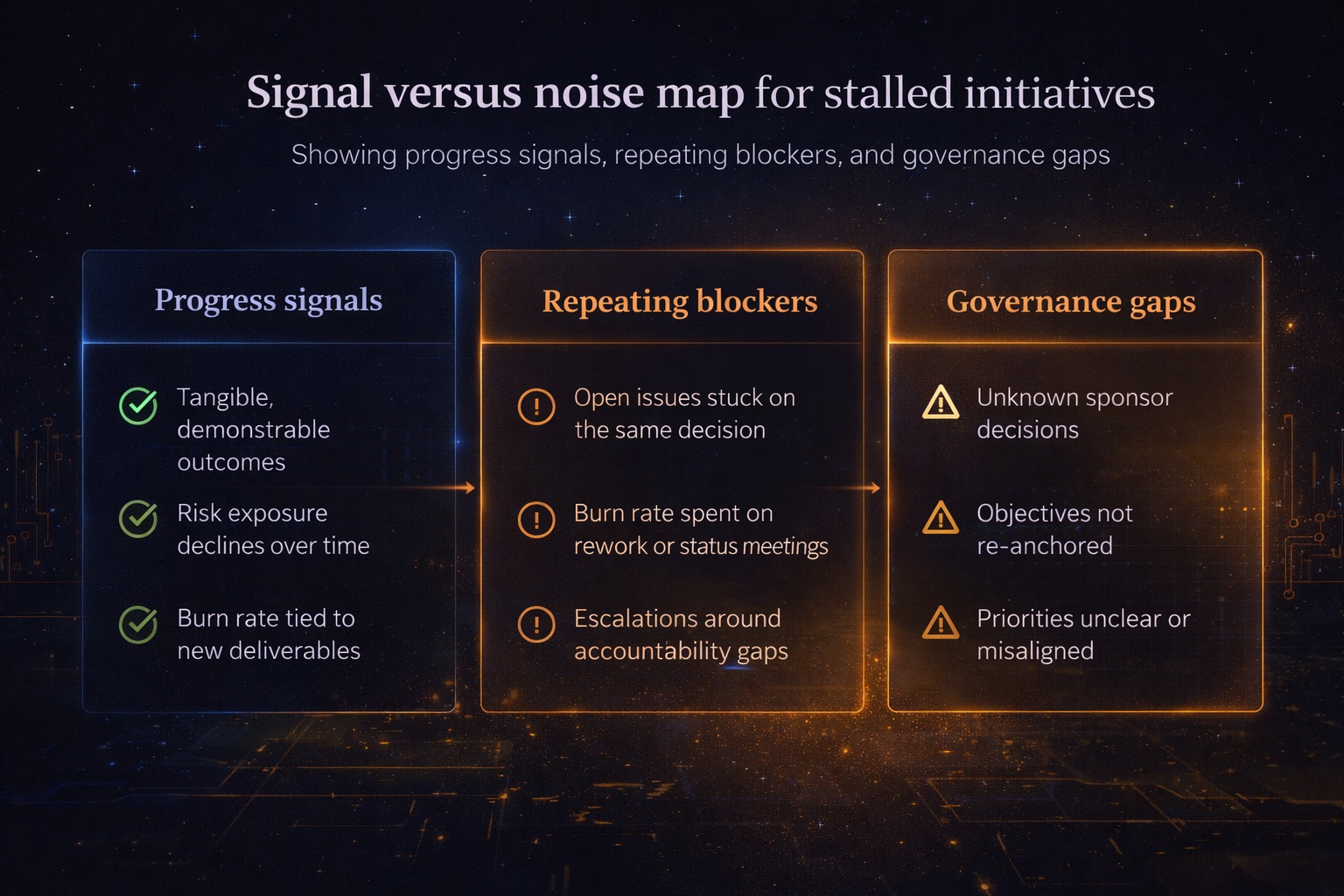
A stall shows repeating patterns. The dates move, but the work does not. Decisions bounce between groups. The initiative rebrands from one theme to another. The team reports effort rather than outcome.
- Milestones slip for two or more consecutive reporting cycles with no scope reduction.
- Critical risks repeat without closure owners or dates.
- Teams report activity metrics such as tickets closed, meetings held, or documentation produced.
- Leaders keep asking for a new plan instead of clearing the same decisions.
- Spend continues while measurable business metrics remain unchanged.
Why technology initiatives stall
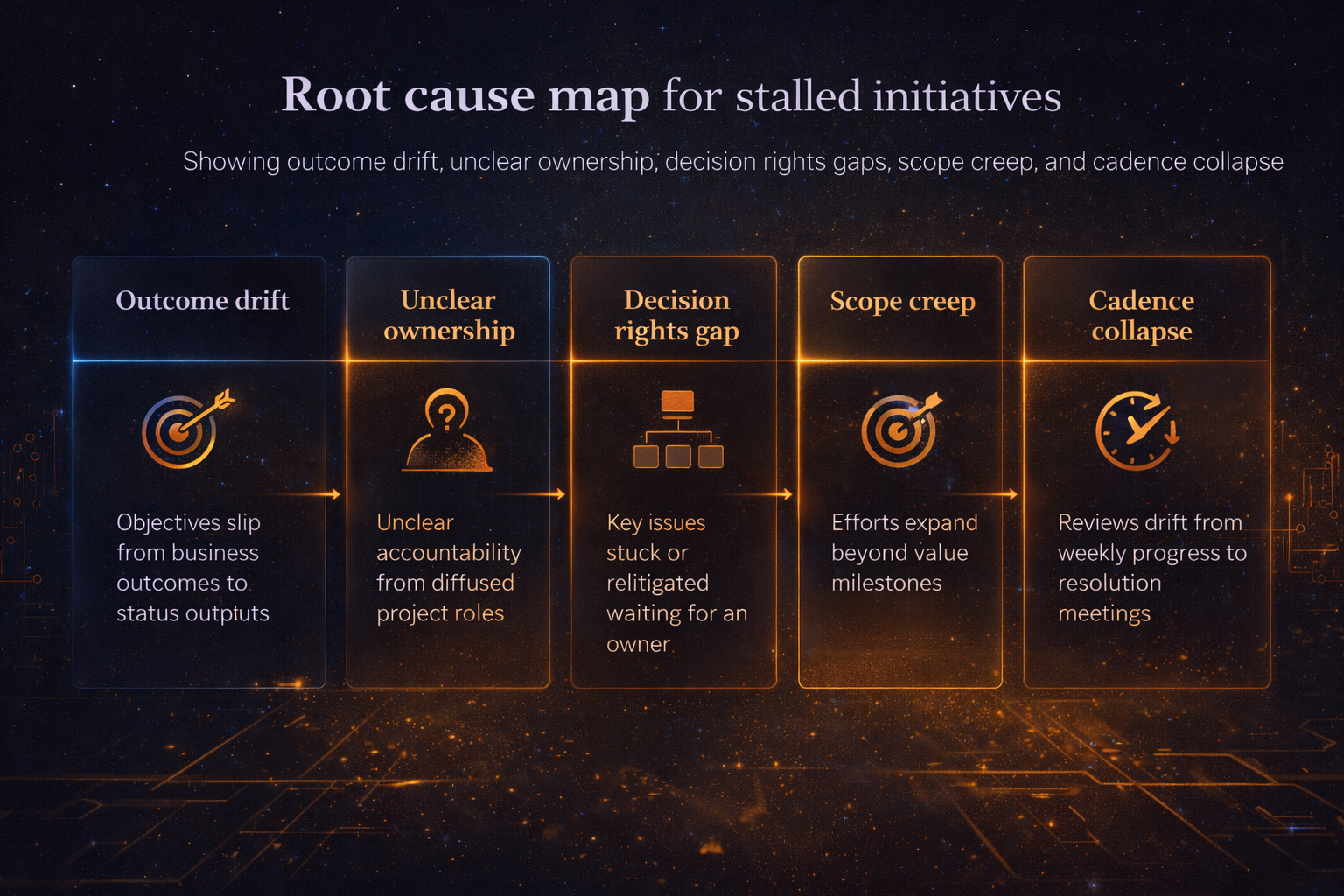
Stalls feel complex. The root causes are consistent. You will see one or more of these governance failures in almost every stalled program.
1. Outcome drift
The initiative starts with a broad goal. Modernize. Digitize. Transform. Teams then create work streams to fill the vacuum. The initiative becomes a collection of activities rather than a path to a measurable result.
When leaders cannot restate the outcome in one sentence, teams cannot prioritize. Work expands. Decision cycles lengthen. The stall begins.
2. Distributed ownership without accountability
Many initiatives have a sponsor, a program lead, a steering committee, and multiple delivery teams. None of those roles creates single accountability for the outcome. Committees replace ownership. When tradeoffs appear, decisions stall because nobody holds the decision rights.
3. Decision rights are unclear
Teams stall when they do not know who decides. Security says no. Architecture says wait. Finance says cut. The business says ship. If escalation paths are unclear, teams keep cycling debates instead of delivering a proof milestone.
4. Scope expansion without stop decisions
Scope growth is normal. Unmanaged scope growth is fatal. Every time leaders add work, they must remove work. When leaders avoid stop decisions, teams overload. Work in progress rises. Delivery slows.
5. Cadence collapse after funding
Leaders approve the initiative. Then they disengage. Reviews become monthly status readouts. Blockers persist. Vendors fill the vacuum with their preferred scope. Without a weekly cadence that forces decisions, stalls persist for quarters.
The reset sequence leaders should follow
Resets fail when leaders jump to solutions. Do not start with tooling. Do not start with a new roadmap. Start with a short sequence that restores control.
Step 1. Separate signal from noise
In the first week, answer three questions in writing.
- Does the initiative still support a measurable business outcome?
- Would we approve this investment today with current information?
- If we stopped in 30 days, what measurable damage occurs?
If answers stay vague, stop and re-validate strategy. If answers are clear, proceed to an execution reset.
Step 2. Re-anchor to one or two measurable outcomes
Choose one primary outcome and one secondary outcome. Keep outcomes measurable. Tie them to a baseline metric. Tie them to a target.
- Reduce release lead time from 21 days to 10 days within one quarter.
- Cut incident volume by 25 percent while maintaining feature throughput.
- Reduce vendor spend by 15 percent through consolidation while preserving uptime.
If you cannot measure the outcome, you cannot manage the reset.
Step 3. Assign owners and decision rights
Assign four named owners. One name per category. Publish them.
- Outcome owner. Accountable for business result and adoption.
- Delivery owner. Accountable for execution plan and delivery health.
- Funding owner. Accountable for spend control and value narrative.
- Risk owner. Accountable for security, compliance, and risk acceptance decisions.
If leaders refuse to assign owners, the initiative stays stalled.
Step 4. Compress scope to a 60 to 90 day value milestone
The goal of compression is proof. Proof creates confidence. Confidence protects focus.
Build a thin-slice milestone. It should ship to a real environment. It should move a measurable metric. It should remove at least one major uncertainty.
- Cut integrations to the minimum required to prove the workflow.
- Remove edge cases and customizations unless they change the outcome.
- Fix the operating model required to run the new capability in production.
Step 5. Install a weekly executive cadence
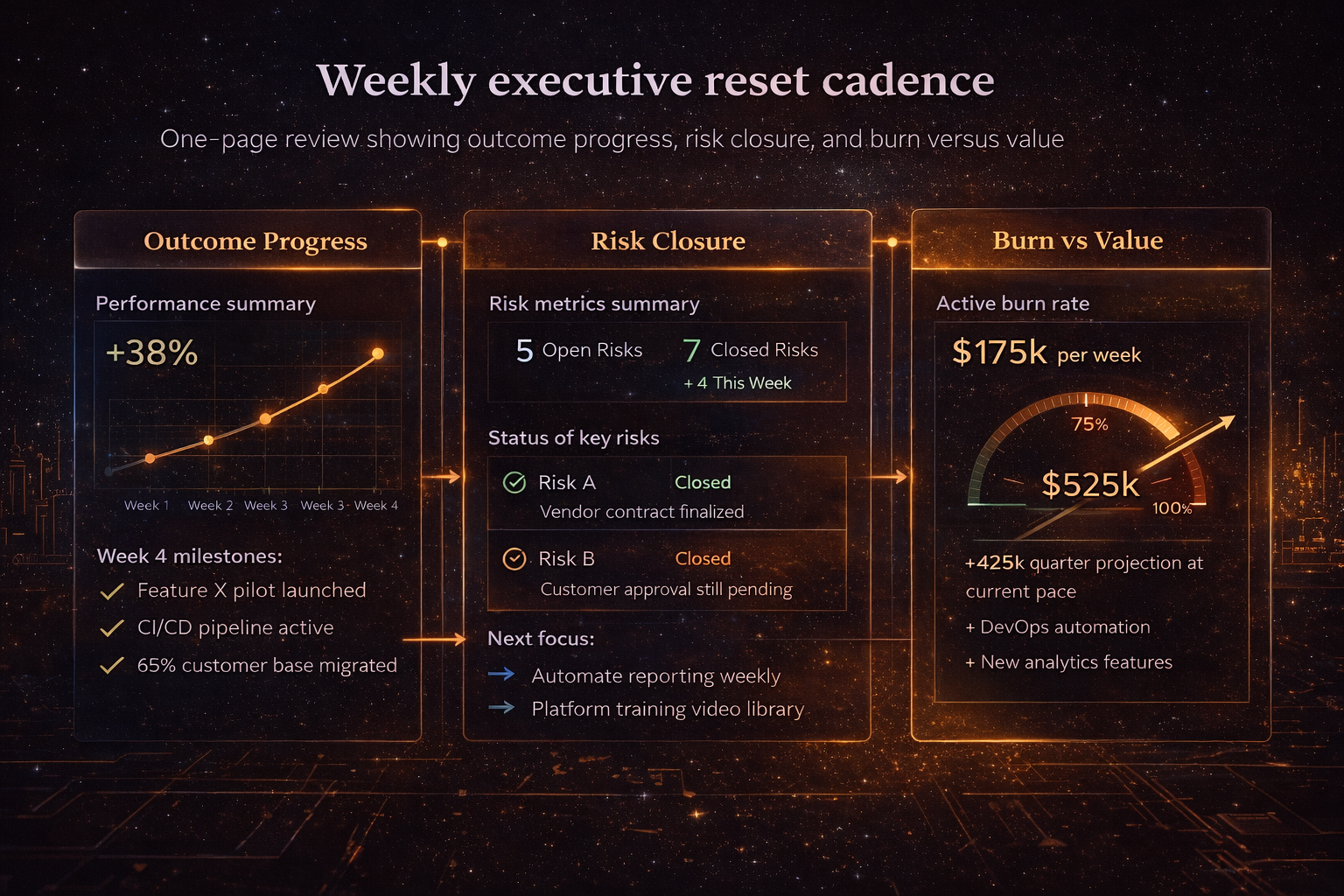
Weekly cadence is where the reset lives or dies. Leaders do not need decks. Leaders need decisions.
Use a single page. Review three metrics every week.
- Outcome progress. Baseline, target, and movement this week.
- Risk exposure. Top risks, owners, closure dates.
- Burn versus value. Spend to date, forecast, delivered proof milestones.
This reset sequence works especially well when paired with a broader execution plan and with the same ownership discipline used in creating accountability across technology teams.
What leaders should ask in the first reset meeting
These questions surface the real blockers. Ask them directly. Record the answers. Convert unclear answers into decisions with owners and dates.
- What outcome moves in the next 60 to 90 days?
- What decision are teams waiting on right now?
- What work stops this week to protect focus?
- What risk do we accept, and who signs for it?
- What will we retire or simplify as part of this reset?
When to terminate instead of reset
Termination is a governance move. It protects capital and credibility. Use a termination test.
- The original outcome no longer matters to the business.
- The economics no longer hold. The remaining cost exceeds realistic return.
- Delivery requires structural change the organization is unwilling to make.
- Vendor or platform constraints make success dependent on terms you cannot accept.
If two or more conditions are true, plan an exit and reallocate capacity.
Frequently Asked Questions
How do you know an initiative is stalled versus simply delayed?
An initiative is stalled when progress signals stop moving for multiple cycles. Examples include unchanged milestones, repeated re-planning, unresolved decision blockers, and steady spend without measurable outcome movement. A delay still shows forward movement and a clear path to recovery.
What should leaders reset first to restart momentum?
Reset the outcome and the decision model first. Confirm one measurable outcome, assign a single-threaded owner, define decision rights, and compress scope to a 60 to 90 day value milestone. Without these, additional staffing or tools increase cost without restoring progress.
What is the fastest way to compress scope without losing value?
Separate must-have value from nice-to-have features. Choose one thin-slice deliverable that proves the outcome, remove non-critical integrations, and lock a short timebox. Keep a clear backlog for later phases so teams do not treat cuts as permanent loss.
What should a weekly executive reset review cover?
Keep it to a single page. Review outcome progress, top risks and blockers, burn versus value delivered, and any decisions leaders must make that week. If a decision repeats twice, assign an owner and a due date.
When should you terminate instead of reset?
Terminate when the original outcome no longer matters, the ROI no longer holds, or the required capability gap is too large for the current structure. Termination protects credibility and frees capacity for work that moves measurable outcomes.
Need a reset plan leaders can run
If an initiative is stalled, a focused working session will surface the real constraints, define ownership and decision rights, and produce a 60 to 90 day value milestone with a weekly executive cadence.
Book a consultation