
Growth governance discipline
During expansion phases, optimism often masks inefficiency. Revenue growth can temporarily hide weak cost visibility, unclear ownership, and reactive vendor decisions. Over time, complexity compounds faster than revenue and margin pressure becomes harder to reverse.
Growth governance discipline means leaders do more than approve spending. They connect every major technology investment to measurable business outcomes, judge capital deployment against margin expansion rather than feature volume, and limit vendor proliferation before duplication and lock-in take hold.
- Align every major technology investment to measurable business outcomes.
- Evaluate capital deployment against operating leverage, not activity alone.
- Limit vendor proliferation without centralized oversight.
- Prevent integration sprawl during rapid product and platform expansion.
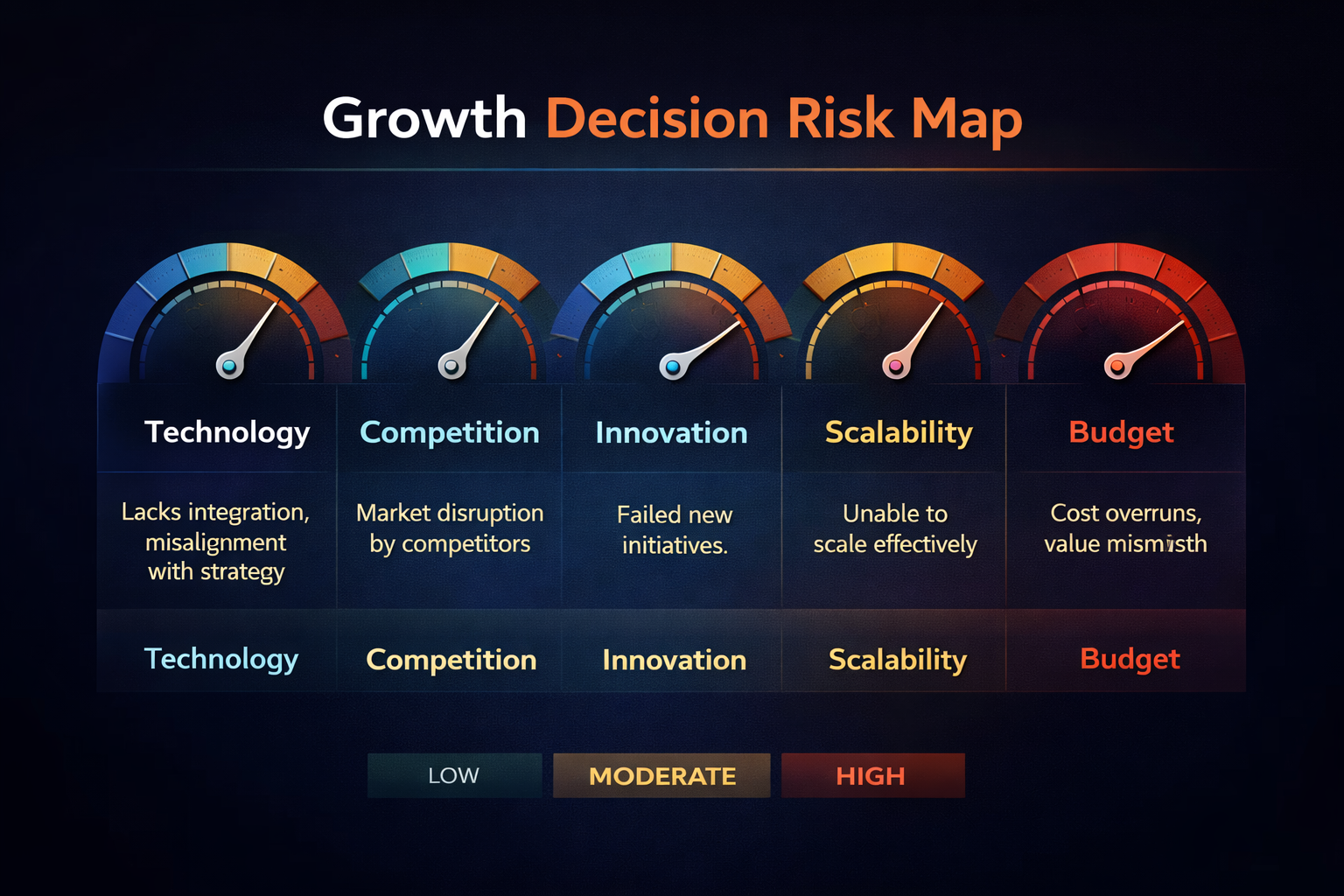
Capital allocation during expansion
Capital discipline separates sustainable growth from inflated cost structure. As initiative volume rises, leaders need a sharper test for where money creates operating leverage and where it simply funds more complexity.
Good allocation discipline requires leaders to ask a small set of questions before approving spend.
- Does this investment increase operating leverage.
- Does it reduce unit cost as revenue scales.
- Does it introduce vendor lock-in risk.
- Does it simplify architecture or increase integration burden.
- Is this initiative competing with higher-return alternatives.
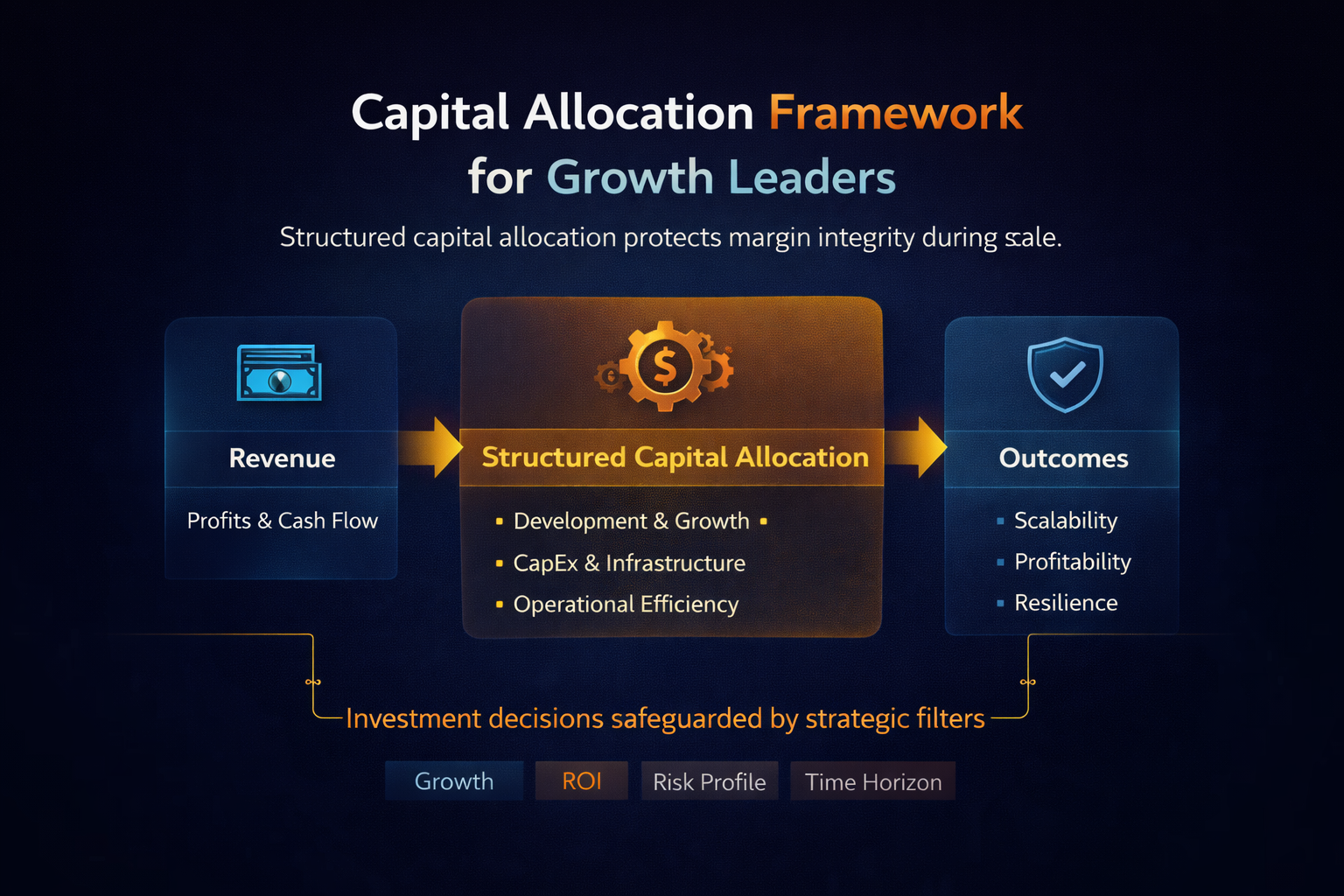
Prioritization under scale pressure
As organizations grow, initiative volume multiplies. Product expansion, infrastructure upgrades, compliance requirements, and vendor integrations compete at the same time. Without structured prioritization, leaders fund too many parallel efforts and reduce the chance that any one of them lands cleanly.
When priorities stay loose, execution velocity slows. Delivery timelines extend. Decision fatigue rises. Teams spend more time coordinating work than finishing it.
Effective prioritization under growth pressure filters initiatives through four executive lenses.
- Strategic impact. Does this move revenue, retention, resilience, or customer trust.
- Operating leverage. Will this reduce future unit cost or increase throughput.
- Execution realism. Do teams have the capacity and sequence to do this well now.
- Risk and dependency exposure. What new complexity, lock-in, or delivery drag does this add.
Prioritization is not an annual planning exercise only. It is a recurring leadership discipline. Growth makes static plans obsolete faster.
Executive decision architecture
Growth demands clarity in decision rights. Architectural decisions need to align with ownership, financial transparency, and integration standards. If authority is unclear, new tools enter the environment faster than the organization can govern them.
Decision architecture should answer a short set of questions in plain language. Who can approve a new vendor. Who can approve a new integration. What evidence is required before a new tool category is added. What financial and operating standards must be met.
- Define authority before vendor selection begins.
- Limit new tool categories unless measurable ROI is visible.
- Align integration standards to the real operating model, not wishful design.
- Reduce single-vendor concentration risk before dependence becomes structural.
- Require cost, risk, and ownership clarity before technical preference drives the decision.
Clean decision architecture protects speed. It does not slow it. Leaders move faster when the approval path, ownership model, and standards are already defined.
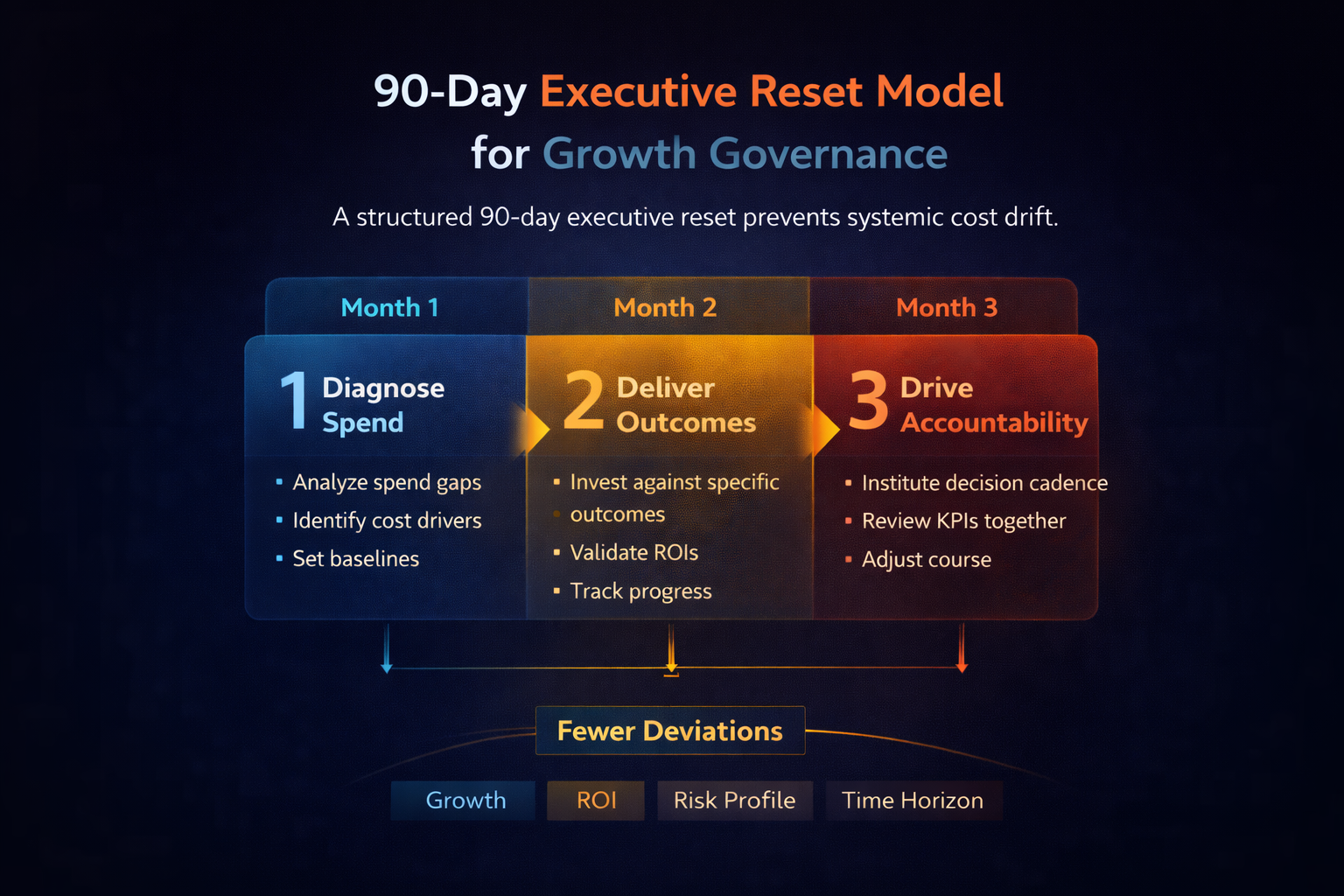
90-day executive reset model
Every 90 days, growth-focused leaders should conduct a structured portfolio review. The goal is not to generate more reporting. The goal is to stop silent cost escalation, clarify what changed, and reset the investment mix before complexity compounds further.
A disciplined quarterly reset should review the following.
- Capital exposure and initiative overlap.
- Vendor concentration and upcoming renewal timelines.
- Cost drift versus revenue acceleration.
- Execution velocity across teams and domains.
- Initiatives that no longer justify continued funding.
- New priorities that now deserve promotion.
Quarterly resets work because they force leaders to revalidate assumptions. What was smart at the start of the quarter may now be marginal, delayed, duplicated, or too expensive relative to current needs.
Executive cadence that protects growth quality
A strong decision model still needs operating rhythm. Growth becomes expensive when leaders review too infrequently or only after a visible problem appears. A stable cadence keeps decisions close to reality.
Monthly growth operating review
- Review top investments by spend, exposure, and expected outcome.
- Review new vendor requests and major integration decisions.
- Review delivery bottlenecks and cross-team dependency risk.
Quarterly executive reset
- Reassess portfolio mix and stop low-return initiatives.
- Review cost drift, margin pressure, and concentration risk.
- Reconfirm owners, decision rights, and current strategic priorities.
Annual strategy alignment
- Test whether the technology portfolio still matches the business growth model.
- Refresh decision standards, investment themes, and platform guardrails.
- Retire structural complexity that no longer serves growth.
Questions leaders should ask before approving major technology spend
Use a short executive filter before approving major technology investments during expansion.
- What measurable business outcome should improve.
- How does this improve operating leverage, margin, or resilience.
- What new complexity or dependency does this introduce.
- Who owns the result after the implementation team leaves.
- What alternative investment would deliver a better return.
- How will we review success within the next 90 days.
Quick answers for leaders scaling fast
- Growth exposes hidden cost. Revenue can mask weak governance for a while, but not forever.
- More initiatives do not equal more progress. Excess parallel work usually slows execution.
- Capital discipline matters more during expansion. Margin pressure often shows up after complexity has already hardened.
- Quarterly resets protect growth quality. Revalidation prevents drift, overlap, and wasted spend.
Frequently Asked Questions
Why do technology decisions get harder during growth?
Technology decisions get harder during growth because scale increases vendor dependence, integration complexity, capital deployment, and delivery risk faster than governance usually matures.
What should growth-focused leaders prioritize first?
Leaders should prioritize investments that improve operating leverage, protect execution capacity, and reduce unnecessary complexity before adding more tools or parallel initiatives.
What is a 90-day executive reset?
A 90-day executive reset is a structured quarterly review of capital exposure, vendor concentration, cost drift, execution velocity, and initiative overlap so leaders can reprioritize based on measurable outcomes.
How do leaders avoid tool sprawl during growth?
Leaders avoid tool sprawl by enforcing decision rights, requiring measurable ROI before adding new categories, limiting duplicate platforms, and reviewing integration burden alongside business value.
What metrics matter most during expansion?
The most useful metrics during expansion are cost drift versus revenue growth, vendor concentration exposure, initiative overlap, delivery velocity, and evidence that investments improve operating leverage.
Need structured growth governance
If expansion increases complexity faster than margin improvement, a focused executive working session will clarify capital deployment, vendor leverage, and prioritization sequencing so growth strengthens operating leverage instead of eroding it.
Book a consultation