
Why cloud modernization stalls
Most programs stall for leadership reasons rather than technical ones. Leaders approve migration targets, then teams encounter conflicting priorities, unclear ownership, and budget surprises. Confidence drops. Complexity rises.
Cloud also changes accountability. In many on-premises environments, risk hides inside shared infrastructure and informal processes. In cloud environments, weak ownership becomes visible quickly.
- Modernization runs alongside normal delivery, so priorities collide.
- Applications move without accountable owners.
- Security controls lag migration activity.
- Spending grows without tagging, budgets, and review cadence.
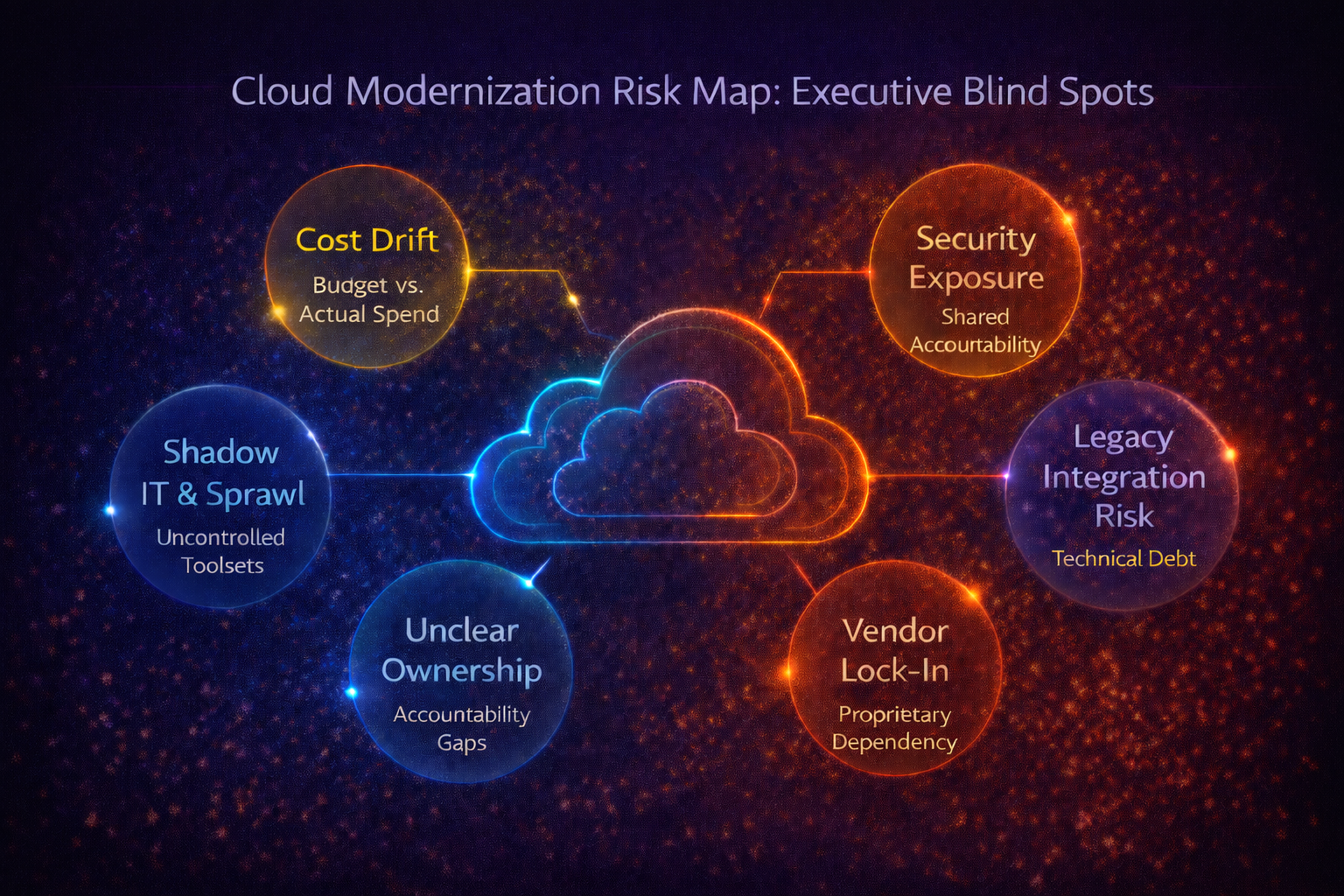
Executive risk map for cloud modernization
Leaders should track risk categories in plain language. Tie each category to an owner, mitigation plan, and timeline.
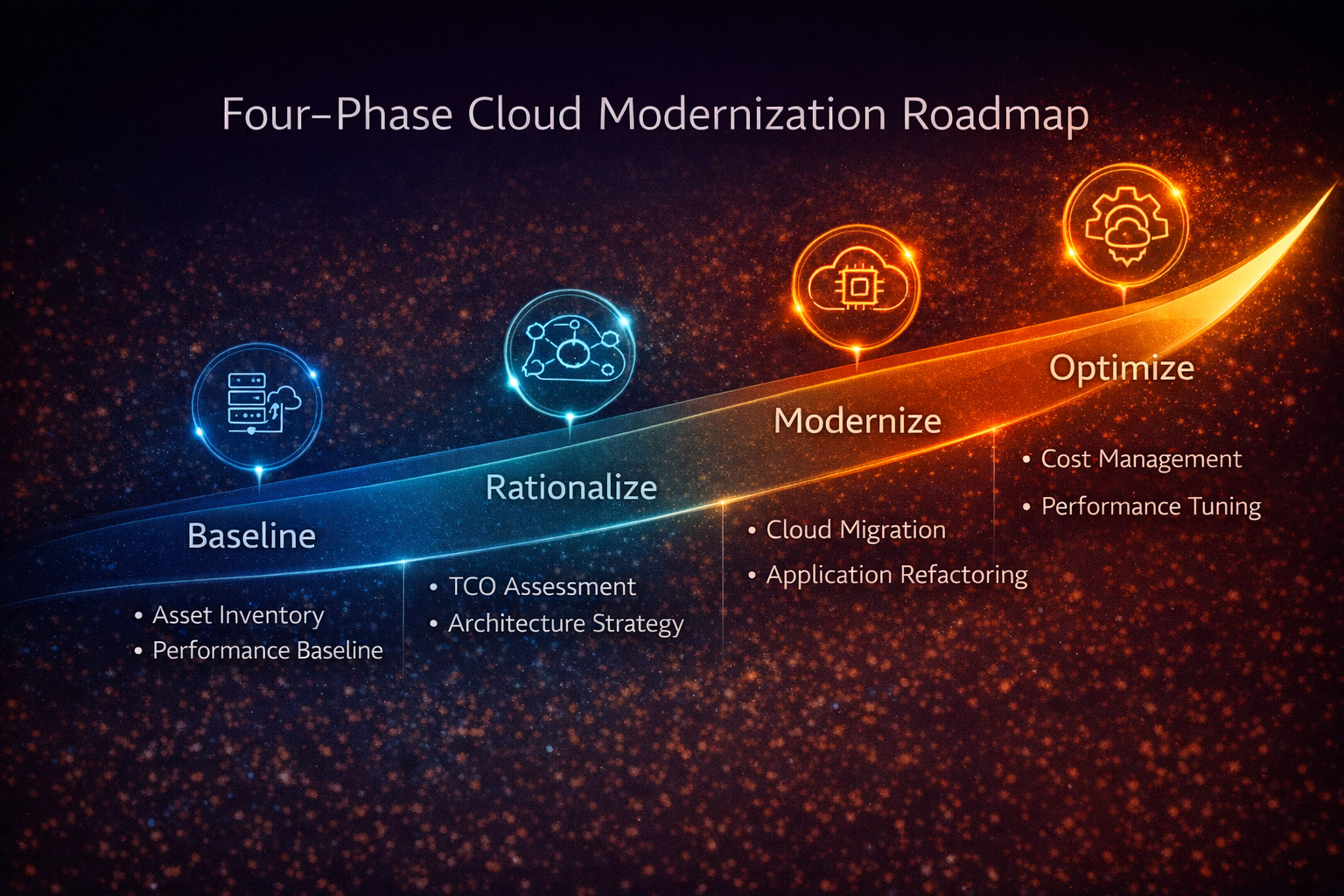
The four phase roadmap
Leaders gain speed when sequence stays disciplined. Each phase has entry criteria and exit criteria. Skipping phases creates rework, cost surprises, and unstable systems.
Phase 1. Baseline and stabilize
Baseline creates control. Without it, progress cannot be measured and accountability remains unclear.
- Establish current run cost across infrastructure, vendors, and operations.
- Identify the ten most critical business systems and data sets.
- Name one accountable owner for each system.
- Define minimum security controls such as MFA, logging, least privilege, and backup standards.
- Introduce tagging, budgets, and cost alerts tied to owners.
Phase 2. Rationalize the portfolio
This phase prevents wasted migration work. Many organizations move systems that should retire.
- Classify each system. Retire, replace, retain, rehost, or refactor.
- Stop migrating systems scheduled for retirement within twelve to eighteen months.
- Reduce duplicate tools and overlapping platforms.
- Define integration boundaries to protect core systems.
Leaders should require a clear rationale for every system decision. If the rationale remains unclear, the decision remains incomplete.
Phase 3. Modernize with guardrails
Modernization changes how teams operate. Delivery becomes automated, observable, and repeatable.
- Standardize deployment templates and pipelines.
- Improve observability through logs, metrics, and health dashboards.
- Strengthen identity and privileged access management.
- Automate provisioning, patching, and scaling.
- Run recovery drills and tabletop exercises.
Phase 4. Optimize and scale
Optimization converts cloud investment into measurable advantage. Governance must stay strong during this phase.
- Right-size workloads and remove idle resources.
- Review budget variance monthly with accountable owners.
- Improve reliability and reduce incident frequency.
- Expand modernization into new domains only after stability holds.
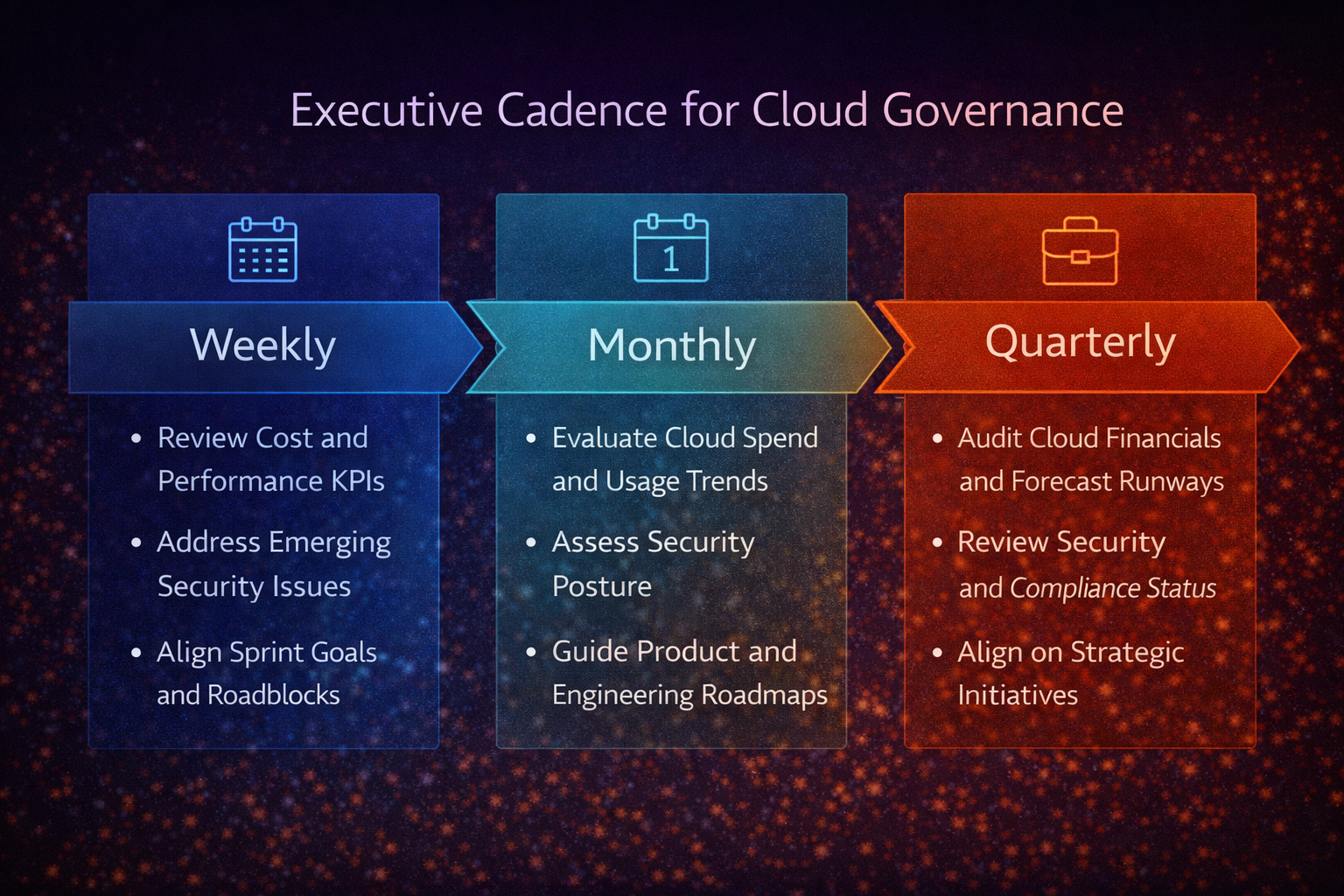
Governance model that keeps cloud under control
Leaders need a stable operating rhythm. Cadence prevents cost drift, security gaps, and delivery instability.
Weekly executive review
- Review top risks and status changes.
- Address decision blockers requiring leadership action.
- Review incidents and near misses.
- Investigate spend alerts above threshold.
Monthly performance and cost review
- Analyze budget variance by domain.
- Review adoption and utilization of major platforms.
- Evaluate change failure rate and delivery stability.
- Review vendor performance and contract issues.
Quarterly portfolio and vendor review
- Reconfirm retire and replace decisions.
- Evaluate vendor lock-in exposure.
- Refresh modernization priorities.
- Approve new migration waves only after stability holds.
Metrics leaders should use
Track a small set of indicators. Focus on trend rather than isolated data points. Each metric should answer a clear business question.
- Cost variance. Are we operating within expected spending ranges.
- Unit cost trend. Are we paying less per transaction, workload, or customer served.
- Change failure rate. Do releases create operational incidents.
- Recovery time. How quickly critical systems return after failure.
- Security control coverage. MFA, logging, monitoring, and tested backups.
- Portfolio reduction. Retired systems and consolidated tools.
Executive diagnostic
Use these questions before expanding migration volume.
- Do we have a clear cost baseline and a monthly variance review with accountable owners.
- Can we name one owner for every critical system.
- Are minimum security controls enforced across all environments.
- Do we know which systems should retire rather than migrate.
- Do we operate with a stable release and incident cadence.
If answers remain unclear, stay in Phase 1 and Phase 2 longer. Early discipline prevents expensive rework later.
First 90 days plan
Days 1 to 30
- Baseline cost and inventory systems and data locations.
- Name owners and confirm decision rights.
- Implement tagging, budgets, and cost alerts.
- Set minimum security requirements for identity and logging.
Days 31 to 60
- Rationalize the application portfolio.
- Define deployment and monitoring standards.
- Start a small migration wave tied to business outcomes.
- Run the first recovery drill and tabletop exercise.
Days 61 to 90
- Prove cost control through variance reduction.
- Expand migration only after stability holds.
- Consolidate tools and remove unused resources.
- Publish an executive dashboard showing modernization progress.
Quick answers for executives
- Cloud modernization changes operating models. It affects delivery, security, and cost governance.
- Do not start with migration volume. Start with baseline, ownership, and guardrails.
- Sequence matters. Baseline, rationalize, modernize, then optimize.
- Cadence prevents drift. Weekly and monthly reviews keep modernization aligned to outcomes.
Frequently Asked Questions
What does cloud modernization mean for executives?
Cloud modernization means improving systems and operating practices so teams deliver faster, run more securely, and control spending through stronger governance, automation, and ownership.
Why do cloud modernization programs fail?
Most programs fail because governance stays weak, ownership is unclear, costs drift upward, and leaders migrate systems that should retire or simplify instead.
What phases should a cloud modernization roadmap include?
A practical roadmap uses four phases. Baseline and stabilize the environment. Rationalize the portfolio. Modernize with guardrails. Then optimize cost, reliability, and scale.
How should executives govern cloud spending?
Executives should govern cloud spending with tagging standards, budgets, alerts, accountable owners, and monthly variance reviews tied to business outcomes and usage trends.
What is the first step in cloud modernization?
The first step is building a baseline. Identify critical systems, name owners, establish cost controls, and enforce minimum security standards before expanding migration activity.
Need a modernization roadmap leaders can run
If your cloud program is moving but value remains unclear, a focused working session can baseline cost, clarify ownership, establish guardrails, and produce a practical 90-day plan tied to business outcomes.
Book a consultation