
Core insights from the CIO Magazine article
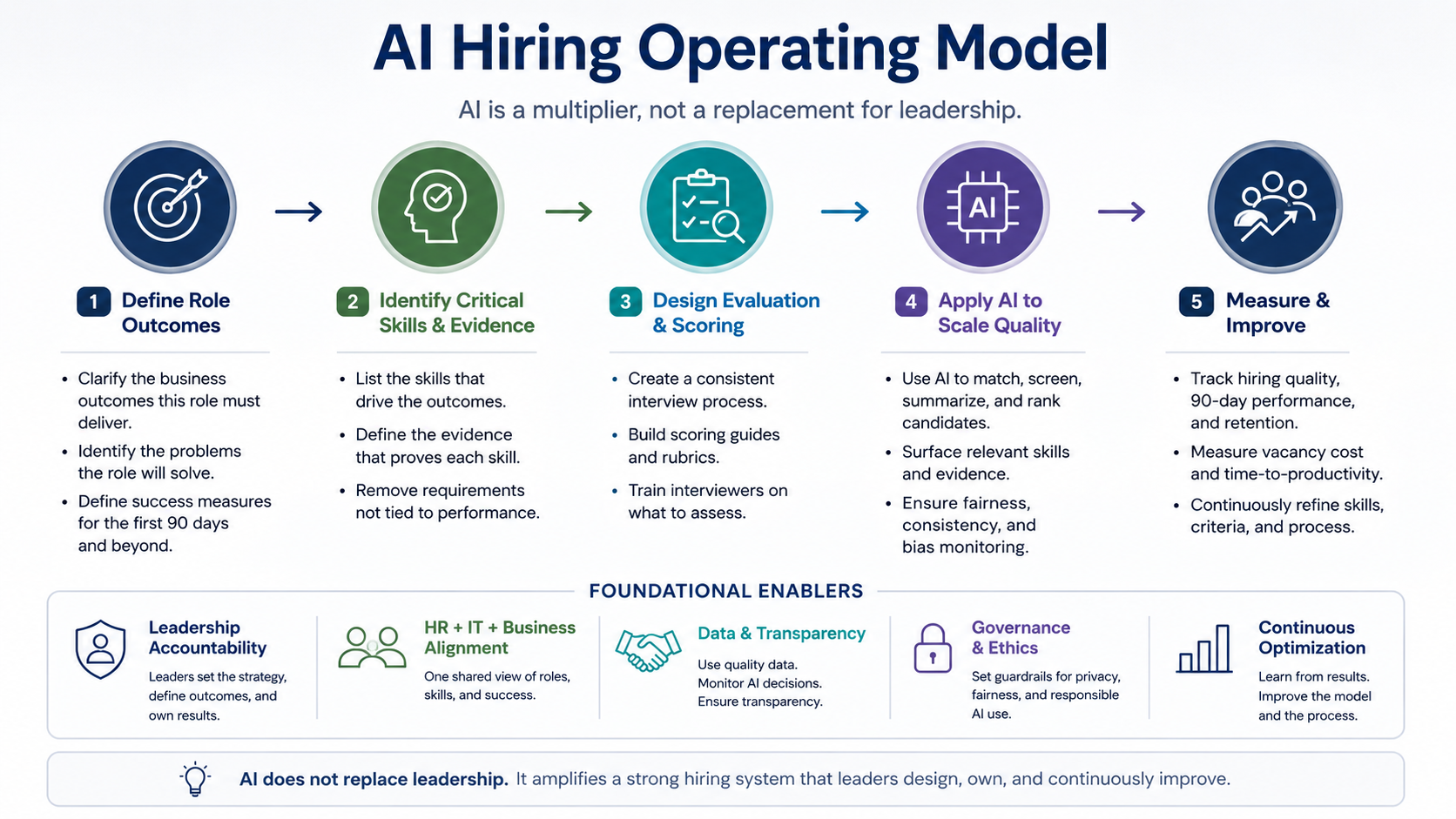
1. AI accelerates hiring. It does not repair hiring judgment.
The CIO Magazine article makes a direct point. AI will not magically find the right talent when the hiring system underneath it is broken. AI screening tools rely on existing data, job criteria, and organizational assumptions.
For leaders, the risk is speed without quality. A faster hiring workflow still fails when role definitions, interview scoring, and success measures remain vague.
- Leadership action. Do not judge hiring tools by speed alone.
- Process action. Review the criteria used to screen candidates.
- Risk action. Check whether strong nontraditional candidates get filtered out early.
2. Skills-first hiring became popular before it became operational.
Many companies say they support skills-first hiring. The gap sits between belief and execution. Leaders remove some degree requirements, then leave the rest of the hiring system unchanged.
Real skills-first hiring requires changes to job descriptions, recruiter guidance, interview rubrics, onboarding, and manager training. Without those changes, the phrase becomes branding instead of practice.
- Rewrite job descriptions around outcomes and skill evidence.
- Train interviewers on what to measure.
- Remove requirements not tied to actual job performance.
3. The failure points are practical, not theoretical.
The article points to job descriptions, screening tools, and internal skepticism as common failure points. Those are fixable leadership problems.
Hiring managers often reuse old templates. Screening tools learn from flawed history. Interviewers bring different definitions of qualified. This creates inconsistency before AI ever enters the process.
- Audit one role from posting through onboarding.
- Compare required skills against actual work performed.
- Give hiring managers a shared scoring model.
4. CIOs see the business cost of weak talent systems.
Technology leaders feel the pain when critical roles stay open, projects slip, or teams lack the skills needed during incidents. A weak hiring system becomes a delivery risk.
The modern technology workforce also looks different now. Strong candidates may prove value through AI projects, workflow automation, platform fluency, cybersecurity labs, cloud deployments, or hands-on training programs.
- Look for evidence of execution, not only pedigree.
- Ask candidates to explain projects they built or improved.
- Track vacancy cost against project delays and team capacity.
5. The best leaders treat skills-first hiring as an operating model.
The better path is practical. Leaders define skills by role, validate those skills against strong performers, align HR and IT metrics, and build talent pipelines before the need becomes urgent.
This turns hiring from a reactive function into a leadership discipline. It gives leaders a better view of quality, retention, readiness, and business value.
- Start with one role where hiring delays hurt delivery.
- Define the skills a top performer uses in the first 90 days.
- Measure retention, ramp time, and promotion readiness.
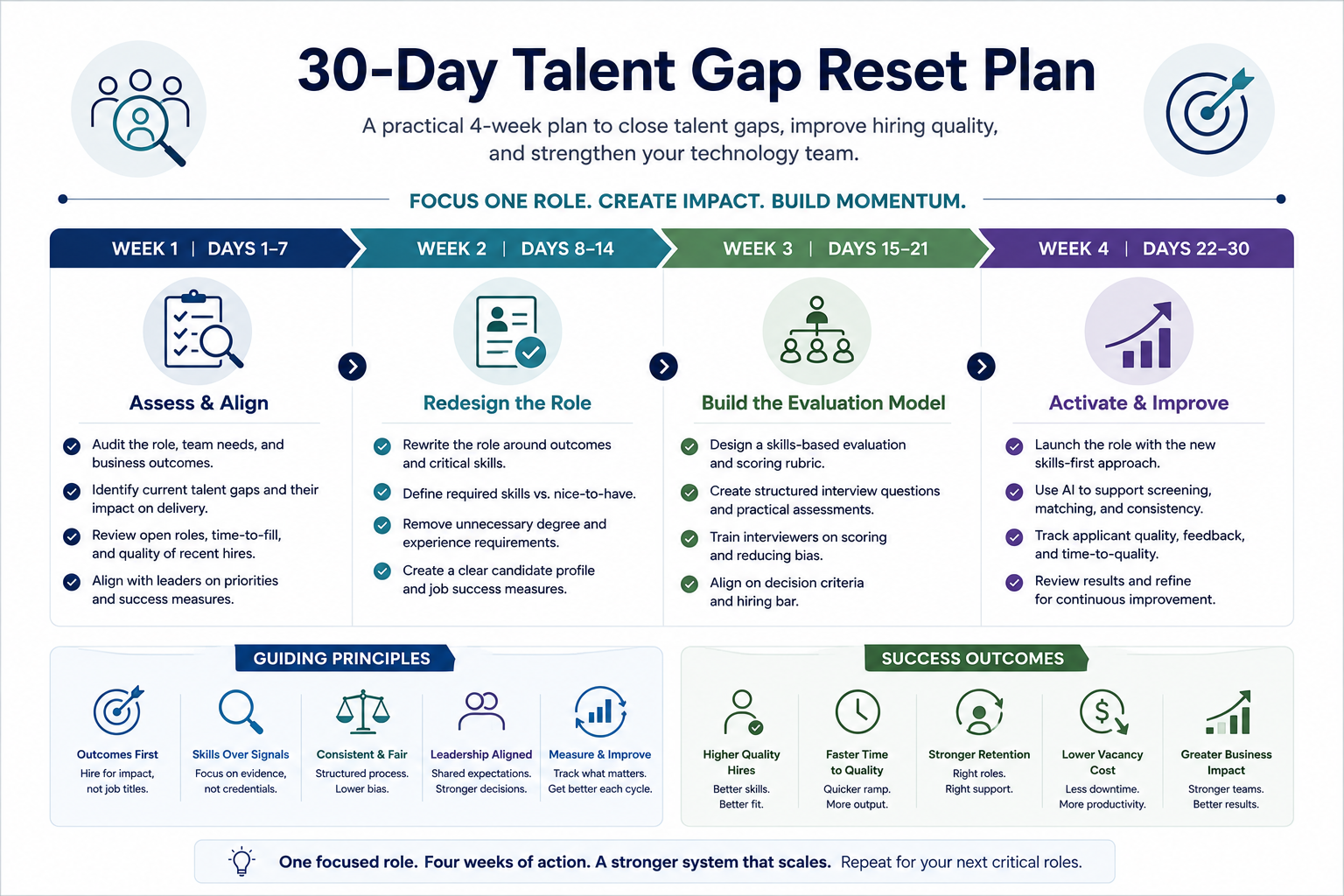
Practical application. A 30-day leadership reset
Week 1. Pick one role with business impact.
Choose a role tied to project delivery, security, operations, data, AI, cloud, or customer experience. Do not start with every role at once.
Week 2. Rewrite the role around outcomes.
Replace vague requirements with clear work expectations. Define what the person needs to produce, support, improve, protect, or deliver.
Week 3. Build the evaluation model.
Create a simple scoring guide. Include technical skills, problem solving, communication, ownership, and learning agility.
Week 4. Add AI after the process is clear.
Use AI to help screen, match, summarize, or organize. Keep leadership accountable for criteria, fairness, and final decisions.
Risks and gaps leaders should watch
- AI screening tools rejecting capable candidates before human review.
- Degree requirements remaining in templates without business justification.
- Interviewers using inconsistent definitions of qualified.
- Hiring metrics focused on time-to-fill instead of long-term performance.
- Talent partnerships created only after urgent vacancies appear.
Related leadership actions
- Hiring. Shift from credentials to evidence. Ask candidates to show how they solved problems similar to the work your team needs done.
- Operations. Connect vacancy data to project delays, team burnout, incident response gaps, and delivery risk.
- AI governance. Review how AI hiring tools rank, reject, and score candidates. Require transparency before scaling use.
- Leadership. Align HR, IT, and business leaders around the same success measures before automating the process.
Frequently Asked Questions
Why will AI not fix tech talent gaps by itself?
AI depends on the hiring system around it. If job descriptions, screening criteria, interview scoring, and leadership alignment are weak, AI speeds up flawed decisions.
What is skills-first hiring?
Skills-first hiring evaluates candidates by demonstrated capability, role outcomes, and practical evidence instead of relying mainly on degrees, years of experience, or legacy job requirements.
Where do skills-first hiring efforts usually break down?
They usually break down in job descriptions, screening tools, interview training, and leadership accountability. Leaders agree with the idea, but fail to redesign the operating model.
What should CIOs and technology leaders measure?
Leaders should measure hiring quality, 90-day performance, first-year retention, promotion velocity, vacancy cost, and whether new hires improve delivery capacity.
How should leaders use AI in hiring?
Leaders should use AI after they define the skills, outcomes, scoring models, and accountability structure. AI should scale a sound process, not replace leadership judgment.
Need help turning technology hiring into an operating model
A focused working session helps leaders clarify talent gaps, define role outcomes, align HR and technology teams, and set practical hiring accountability. You leave with clearer priorities, stronger ownership, and a 30-day action path.
Book a leadership conversation